Monday, May 3, 2021

Why I Now Digitally Caption Copies of Ancestor Photos

In the past few months, I've been increasing my use of digital captioning on copies of scanned ancestor photos. 

It's an easy process: First, I create a digital copy of my scanned original photo. Next, I use photo software to write name and date on the copy. Then I save the photo with a "caption" notation in the file name.

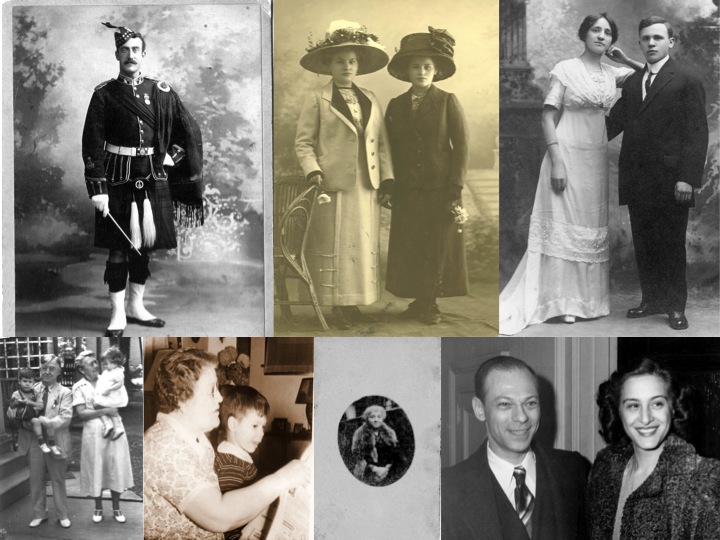
If I'm going to post the photo on a public genealogy website, I now add an attribution to the caption (see photo).

Why digitally caption old family photos?

  1. Keeps photo and caption together. Too often, photos and captions are separated. Maybe a relative wrote a note that was (ouch) clipped to a photo or a photo was removed from the album for scanning or storage, leaving the caption behind. With digital captions, descendants and researchers won't wonder who's in the picture (dates and places are a plus).
  2. Convenient digital sharing. Especially when I connect with cousins for the first time, captioned digital photos allow me to easily share ancestor faces, names, and dates. It's convenient because the captioned versions are self-explanatory. I can always share non-captioned photos, if needed, because the original scan is intact.
  3. Give credit where credit is due. I want to make it crystal clear whose photos these are. I don't obscure a big part of the photo in doing this, but I do want to acknowledge which family is kindly sharing the photo.  
Of course I realize that photos on public blogs (like this) and on public trees are visible to the world and easily copied. 

On genealogy sites such as Ancestry, it's quite common (and encouraged) to have photos and documents saved to other members' trees. The Ancestry system automatically includes the notation of who originally uploaded the image and when. 

That little notation makes all the difference. It credits me as the person responsible for submitting the image, and it acts as cousin bait in case someone wants to get in touch to discuss ancestors. 

This isn't the same as copying from my tree or my blog and moving a photo to an entirely different website.

No copying and reposting without permission

Recently, Judy Russell, the Legal Genealogist, wrote a detailed blog post explaining that copying photos and reposting without permission is illegal. Judy linked to the terms of use for several major genealogy websites. She included an excerpt from Family Search, indicating that users are legally responsible for content they post.

I'd just discovered that someone I don't know had copied some photos from my Ancestry family tree, without my knowledge or permission, and put them on the Family Search tree. Judy's comments encouraged me to take action.

After writing that person to ask whether we are related, with no answer, I tried a more direct approach. I politely and firmly requested that my photos be removed because they violate the Family Search terms of use. I said I would contact officials at Family Search and make them aware of the violation if my photos weren't deleted.

Within one hour, the user answered with a terse note saying the photos were taken down. I confirmed they were gone and responded: "Much appreciated."

My digital attribution ("courtesy: Wood family") is a strong and unambiguous public statement of the source of the photo. If all my public photos had this attribution, I suspect none would have been copied and posted to Family Search.

--

The Genealogy Blog Party's May theme has to do with photography. This is my entry!

Saturday, May 1, 2021

My 1950 U.S. Census Release To-Do List: May 1 = Moving Day

This year, I'm taking steps to find a street address for each key ancestor enumerated in the 1950 U.S. Census. I want to be ready to find them when the unindexed Census records are made public in 2022.

Even when I do find these ancestors in the Census (browsing images in the Enumeration District where each lives), I have to remember that within a month, some city-dwellers could be living elsewhere.

The Tradition of Moving Day

In the Big Apple, May 1 was when all rental leases expired. The same was true in Chicago for many years, and other big cities as well.

Families that lived in apartments spent the weeks before May 1 talking with new landlords who might be willing to negotiate rents or offer another incentive to move. Renters also signed contracts to have moving companies lug furniture to the new place on Moving Day.

Moving Day is unlikely to change where I look for my urban ancestors in the 1950 Census, since they were probably counted in the early days and weeks of enumeration. But it does remind me that the 1950 Census address might be only one in a long line of address changes for each ancestor.

Look for an address after May 1949

My recently married parents (Harold Burk and Daisy Schwartz) were in their second New York City apartment by the time of the 1950 Census. Their parents and other relatives, however, weren't necessarily living in the same apartment in April of 1950 as they were in April of 1949.

Similarly, in the Chicago branch of my family, many were renters. From one Census to another, I noticed that many of these ancestors changed apartments--and very likely they moved more than once in the decade between each Census Day.

So as I research my New York City and Chicago ancestors who were renters, I'm trying to find addresses after May of 1949. I'm looking at birth records of their post-WWII babies, city directories, phone directories, advertisements, news articles, and social items in the newspaper, among other sources. 

--

This is part of my series of blog posts about getting ready for the 1950 Census release, which will occur on April 1, 2022. 

Friday, April 30, 2021

What's NOT in the Picture?


This week, my wonderful husband used Google Street View to "look" at different parts of his old neighborhood in Cleveland Heights, Ohio. We've used Street View before, mostly looking at family homes and schools. This time, he explored further from his childhood home.

He remembered a line of sturdy brick storefronts, similar to the stock photo above, within walking distance from where he grew up.

He was shocked when he saw what the area looks like today.

No stores along what used to be a busy shopping street. No drug store, no record store, no movie theater, no hair salon, no deli. 

These favorite places from his past had been completely demolished.  

Reconstructing the past

Seeing the dramatic changes to that street caused him to reach back into his memory bank and mentally reconstruct the line of stores that once stood there.

In his mind's eye, he could see the entire block and tell me exactly what was gone. He remembered funny stories from his first after-school job at the drug store. He recalled buying albums at the record store, snacking at the deli, taking dates to the movies. He even summoned up the names of friends who worked at some of these businesses. 

He told me new stories as he mentally took a nostalgic and emotional walk down memory lane, one favorite place at a time.

Trying to spark memories

I haven't been quite as surprised using "Street View" to look at old neighborhoods in my hometown of New York City, maybe because it's the city that never sleeps. 

Still, I'm going to try exploring other favorite places from my childhood to see whether the changes spark new memories that I can discuss with relatives. What's NOT in the picture might stimulate fresh thinking about the past. 

--

"Favorite place" is this week's #52Ancestors prompt from Amy Johnson Crow.

Tuesday, April 27, 2021

My 1950 U.S. Census Release To-Do List: "Who Was There" List


With my eye on the public release of the 1950 U.S. Census in less than a year, I'm preparing to look for ancestors I'm particularly interested in.

No indexing will be available on April 1, 2022, so the only way to find these ancestors at first will be to browse enumeration districts where they were living. The catch is, I need some idea of where each ancestor was residing in 1950. 

Generating a RootsMagic "Who Was There" List

As an experiment, I opened my RootsMagic7 genealogy software and looked for a report that might give me a head start in grouping ancestors who were (1) alive in 1950 and (2) living in a certain area.

At top is a screen shot showing me preparing to generate a list of "Who Was There" in Ohio in 1950. I set the parameters for everyone in that particular tree (my husband's Wood family). 

I could have narrowed the parameters to everyone in Cleveland, Ohio, for instance. 

In this case, the list for Ohio ran for a dozen pages. It was initially organized alphabetically by surname, showed birth and death dates, and showed in detail each person's residence and key facts. A bit too much detail, but I expect to learn how to refine the list as I gain experience.

Next, Save and Sort the List

Importantly, I was able to save this list in my choice of formats. I selected .rtf so I can open it in Word and then sort as I please, choosing to sort by any of the columns. 


Here is an excerpt of the Wood list for 1950, sorted by "place" (the final column). This gives me a starting point for seeing where each ancestor was in 1940 and then researching a more specific residential location to search in the 1950 Census. Only a starting point, because I'm also looking for more recent directories and other sources to bring me closer to the 1950 address.

About the column marked "age"--it indicates the ancestor's age in 1950, not the ancestor's age at death.

This experiment encourages me to explore more ways to use the software and learn more of its functions on the road to the 1950 Census release next year.

--

For more posts about prepping, please see my special page on the 1950 Census.

Friday, April 23, 2021

DNA + Trees = Powerful Cousin Bait

Name your family tree so DNA matches can get a glimpse of names and places
 

Fishing in many ponds, my DNA results are on Ancestry, MyHeritage, FamilyTree DNA, GedMatch, and 23 and Me. My husband's DNA results are on Ancestry, MyHeritage, FamilyTree DNA, GedMatch, and LivingDNA.

To add to the power of DNA matching, I've uploaded at least a basic family tree where trees are allowed. This enhances DNA as cousin bait, allowing matches to investigate our possible connections. 

Also, as shown above, I include surnames in the name of the tree, along with specific surnames and locations in the tree description. I want to encourage DNA matches (and researchers) to explore further and envision possible connections in different branches. 

In my view, a name like "Frank's Tree" or "Family History" doesn't convey anything about the tree or the ancestors. 

Why not take the opportunity to boost the combined power of DNA and trees by providing an informative tree name where you have that opportunity? The tree name is another genealogical clue!

--

"DNA" is the #52Ancestors prompt for this week, and the theme of this month's Genealogy Blog Party.