Sunday, June 21, 2020

Remembering Fathers in Our Family Trees

Brice Larimer McClure (left), Edgar James Wood (right)
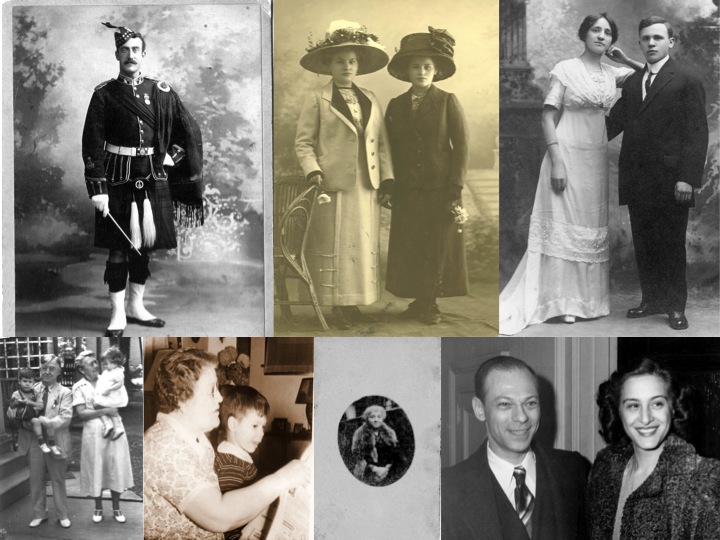
Today is Father's Day! To celebrate, I'm remembering the fathers and grandfathers in my husband's family tree and in my family tree.

Hubby's Father and Grandfathers

James Edgar Wood
At top: Edgar James Wood (1903-1986), my hubby's father, very much enjoyed the company of his father-in-law, Brice Larimer McClure (1878-1970). They got along well and after Brice was widowed, he was included in Wood family dinners nearly every weekend and for every holiday.

I'm grateful to Brice, my husband's maternal grandfather, because he made notes of names and dates in the family tree--giving me a head-start on my genealogy research.

My husband's paternal grandfather was James Edgar Wood (1871-1939), a carpenter and home builder who came from a long, long line of carpenters. His father had been a carpenter and a coach-builder with the railroad. None of James's sons took up carpentry--all became white-collar professionals.

My Father and Grandfathers


Harold Burk
My Dad was Harold Burk (1909-1978). He was on his way to becoming a travel agent when World War II interrupted his plans.

Enlisting in the US Army, he was stationed in Europe and returned home in October of 1945, after the war ended.

Back in civilian life, Dad settled down with my Mom and pursued his dream of being a travel agent. He quickly opened his own travel agency in the lobby of New York City's swanky Savoy Plaza Hotel, and remained there until the hotel was torn down.

Harold's father, my paternal grandfather, was Isaac Burk (1881-1943). At the very start of the 20th century, Isaac and five of his siblings left their home in Gargzdai, Lithuania, making their way to new lives in North America.

Isaac Burk
Isaac and his older brother Abraham were both trained cabinetmakers. Unfortunately, Isaac died of a heart attack while his two sons were serving abroad in World War II. It was my quest for Isaac's death date, place, and cert that started me in genealogy some 22 years ago. That was my very first blog post in August of 2008.

Theodore Schwartz

My maternal grandfather was Theodore "Teddy" Schwartz (1887-1965). He left his bustling home town of Ungvar, Hungary to settle in New York City early in the 1900s. He worked as an agent for steamship lines and other jobs before marrying and beginning a family.

At that point, Teddy opened his own dairy store in the South Bronx. That store is one reason the family weathered the Great Depression fairly well (except for the day Teddy's store was robbed).

In the wake of the Depression and WWII, Teddy was a great admirer of President Franklin D. Roosevelt. I recall seeing a newspaper photo of FDR pinned up in the apartment for many years.

Remembering these fathers and grandfathers with love and keeping their memory alive on this Father's Day of 2020.

Thursday, June 18, 2020

Who's Hidden in That Tintype?

Mystery tintype, before
and after enhancing
My first adventure in mystery photo land has turned up an unexpected discovery!

This adventure combined the sharpening power of the new MyHeritage.com photo enhancement tool with the cleanup and lightening capabilities of Restore software from Vivid-Pix.

Scanning and Cleaning Up The Tintype

It all started with a dark tintype, which I inherited without any frame or identification. I despaired of getting anything from it, and had never even tried to scan it.

Yesterday, I scanned it at high resolution (with my trusty CanoScan 8400F flatbed). Top right is the result. At this point, I could see the shadow of a seated woman and a standing man in a bowler hat. Of course I had to continue!

My next step was to lighten the scan slightly with my Picasa image management software (alas, no longer offered by or supported by Google). More of the people could be seen. I was feeling encouraged to continue with an even more powerful tool.

Vivid-Pix and My Heritage to the Rescue

The image was still so badly degraded that the faces were not visible. So I put the digital image through Restore by Vivid-Pix.

Restore gave me 9 possible images from which to choose when it fixed the image. I chose the one in which the people were most delineated. After a bit of tinkering with the software's tools, I could definitely see where a frame used to be over the tintype, and more of the faces. That's the bottom image above.

Finally, I imported the fixed image into MyHeritage's photo enhancement tool. The result was much clearer faces and clothing. The tintype had been rescued!

Comparing Known Faces for Identification

Look at the man's face--long and lean, with ears sticking out a bit. The woman's face has distinctive eyes and eyebrows. I had a suspicion now.

I uploaded to MyHeritage two photos of my paternal grandparents, Henrietta Mahler (below left, just before their marriage) and Isaac Burk (below right, 25 years after their marriage).

After sharpening their facial features, and comparing with the super-enhanced scanned tintype, I found myself unexpectedly staring into the younger faces of my grandparents, probably around the time of their marriage, pre-1910. That's my best guess on identification.

Wow. Very unexpected to be able to finally tease out recognizable faces from this degraded tintype, well more than a century old. For me, it's also a great demonstration of how combining new tech tools can help my genealogy efforts.


This week's prompt from #52Ancestors is  "unexpected." We're already at week 25, nearly halfway through the year of Amy Johnson Crow's genealogy prompts.

Tuesday, June 16, 2020

Sharpening the Focus on Mystery Faces

1915 photo of Schwartz siblings, enhanced via MyHeritage.com


The recent announcement that MyHeritage.com is offering a new photo enhancement tool gave me an idea.

After testing photo enhancement on some century-old family photos, I realized that sharper faces will help me with my mystery photos.

Known Faces in Focus

As shown above, the MyHeritage tool not only sharpens faces, but also provides small vignettes of each person in the photo. The features are much clearer!

These are my Schwartz great aunts and a great uncle in Ungvar, Hungary (now Uzhhorod, Ukraine), siblings of my maternal grandpa Theodore "Teddy" Schwartz.

Mystery Faces in Focus

My next step is to dig through the "mystery ancestor" box for my Schwartz line* and upload photos to MyHeritage. After I've used the photo enhancement tool, those mystery faces should be much clearer and distinct!

By comparing enhanced faces of mystery ancestors with enhanced faces of known ancestors, I hope to more confidently identify people as being in a particular branch of my family tree. At the very least, I can write a caption explaining a tentative identification for the sake of future generations.

Let's see what happens as I get some mystery faces in focus!

* I've sorted my mystery photos into "best guess" families, with possible ancestors of my mother's family separate from possible ancestors of my father's family. Also I've separated mystery ancestors from my husband's family tree, to avoid having the mystery photos mixed up in the distant future when I someday join my ancestors. This is a tip from my book, Planning a Future for Your Family's Past.

Saturday, June 13, 2020

Sifting Through Hints for Cousin Bait

Use surname filtering to focus on cousin bait

If you're looking for cousin bait, you have to focus your attention on the most productive possibilities when sifting through family-tree hints on Ancestry.

At left, the hint summary for my husband's family tree on Ancestry. There are 3,200 people on this tree, so it's not surprising that I have so many total hints.

Stories and photos are often very good cousin bait, especially if you filter the hints by surname as you focus on specific ancestral lines. Then you can look at the contributor's profile and tree (if public) to see how he or she fits into your family tree. (I'm not going to talk about DNA or ThruLines in this post--topics for another time!)

Stories as Cousin Bait

In this case, I looked at all 21 of the "stories" to see what they are, who posted them, and how many were personal vs. transcribed documents or records. Most could be seen without downloading any files (which I won't do unless I know the person, just in case).

Many of the stories were summaries of family histories with footnotes leading to county histories or other books. Two were transcriptions of will/probate materials for distant ancestors. All useful in my research, but not specifically cousin bait, although of course I checked to see how the contributors might fit into the family tree.

A good number of these 21 stories were transcriptions of oral history from someone who actually knew one of my husband's ancestors! Great cousin bait. I've now invited that contributor to see my public family tree, and he has invited me to see his public family tree. There is a distant cousin connection here, and the oral history posted as stories served as effective cousin bait to reel me in.

Photos as Cousin Bait

Ineffective as cousin bait
My favorite cousin bait (to leave as bait or to follow as bait) is a personal photo of an ancestor.

With 627 photo hints to sift through, I narrowed the focus by specifying a particular surname for searching photo hints.

Within the photo hints for McClure were dozens of flags, patriotic images, DNA symbols, and other non-personal images.

These are NOT effective cousin bait. Folks like to use such images to tag certain categories of ancestors, but they don't work well for cousin bait.

On the other hand, the photo shown below is top-notch cousin bait I discovered when searching photo hints for Larimer, another of my husband's ancestral surnames.

Effective cousin bait: A personal photo with a title
Not only is it a real photo, it has a title that indicates who and what the photo is about (I masked some info for privacy). I've confirmed that the person who posted the photo is actually a cousin. He has meticulously researched his branch of the tree and we are now guests on each other's family trees, sharing info about the Larimer line.

For all the other record hints, I will filter by surname and work down the list. I don't generally check family tree hints this way, by the way. Instead, I look at them when I'm researching a particular ancestor.

Have fun with #CousinBait! 

Thursday, June 11, 2020

Tricking the Search System into Finding Thomas and Mary

Thomas H. Wood and son Alfred, son Charles, son Frank, daughter Jane
in the 1881 city directory for Toledo, Ohio (wife Mary isn't mentioned, grrrrr)
As I continue my Genealogy Go-Over and fill in missing details for ancestors on my husband's tree and my tree, I can't always find what I'm seeking with a simple search.

Case in point: my husband's great-grandpa, Thomas Haskell Wood (1809-1890), and great-grandma, Mary Amanda Demarest Wood (1831-1897). I have their US Census records for 1850, 1860, and 1870.

But even trying Ancestry, Family Search, and My Heritage, Thomas and Mary couldn't be found in the 1880 US Census via indexed search of transcribed names.

Where Are You, Wood Family?

For many years, great-grandpa Thomas and his family were at 170 South Street in Toledo. That's the address shown in the page from the 1881 Toledo city directory (see image at top). The family lived on South Street in the 1880 city directory and in earlier years.

Thomas didn't die until 1890, and his wife outlived him. They were definitely on South Street at the time of the 1880 Census. I guessed that they were not transcribed and indexed properly by any of the major genealogy sites.

Although I knew I would find Thomas and family if I searched page by page through the 1880 Census, there was a faster way to find them--a favorite search technique I learned from my friend, Toni McKeen.

Search for First Names Only

Searching by first name, birth year/location, residence
Toni suggests searching a specific database by first names, no last name, in a particular location. The key is to search for more than one name in that household. This "tricks" the search system into ignoring the last name, which was mistranscribed, and only focusing on first names.

I went to the Ancestry catalog and selected the database for the 1880 US Census. As shown in this screen shot, I then entered first name "Thomas" (no last name), included his birth year and birth state, and listed his spouse "Mary" with no last name. I inserted "Toledo, Lucas, Ohio" in the "lived in" section.

The very first result for this search showed a "Thomas Ward" born about 1809 in Massachusetts, with wife "Mary A" in Toledo. It's not "Wood" but it is a really close match. Next step, look at the image.

Correct Result, Correct the Transcription 


1880 Census entry for the Wood family, mistranscribed as Ward

As soon as I saw who was in this household, I recognized that it was, in fact, my husband's great-grandpa and family. The first names were correct, the residence on South Street matched, the birth places and occupations and children/ages were as expected in 1880.

Submitting a correction so future researchers
find Thomas and Mary Wood and family

Obviously, "Wood" looked a lot like "Ward" to all the transcribers. I submitted a correction for every member of that household (on all three genealogy websites).

Now I will review the pages before and after Thomas and Mary's Census entry in search of the FAN club, specifically any future spouses of the Wood children who were of marriage age in 1880.