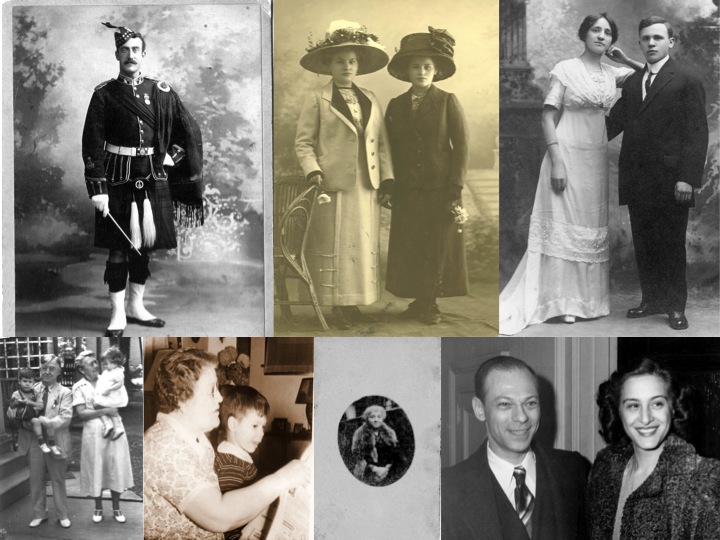
Monday, November 18, 2019

Julius Farkas Was a WWI Conscientious Objector

World War I service of great uncle Julius Farkas
My great uncle Julius Farkas (1892-1969) came to New York City from his native Hungary when he was 11 years old. He hadn't seen his father for four years at that point, nor his mother for three years, because they wanted to get settled in America before sending for their children. His dad, Moritz Farkas, and his mom, Leni Kunstler Farkas, sent for the children in two waves--and Julius was in the second wave.

He was one of two "bachelor brothers" in my mother's FARKAS family, never marrying but very close with his siblings. I remember little about him except his smile as he held an unlit but smelly cigar in his hand during family gatherings.

Drafted for World War One

Julius was 25 years old when he was drafted to serve in the U.S. Army during World War I.

When Julius filled out the draft registration card, he wrote his occupation as "Panama hatter" (the craze for those hats had already peaked). He said he was a naturalized citizen, born in Nagy Bereg, Hungary.

But this registration card was different from others I've seen from my family.

At the bottom, Julius claimed exemption from military service on the basis of "conscientious objection." 

Julius in the Army


Like other conscientious objectors in World War I, Julius was given the opportunity to serve in a non-military capacity. He was a confirmed bachelor who lived with his brother or other family members for his entire life. He never cooked professionally, and his cooking skills were almost certainly very limited.

Of course Julius was assigned as an Army cook. However, instead of being shipped overseas with Battery D, 305th Field Artillery, he was transferred to a different unit, as shown above in a transport list from April of 1918. Julius's name is crossed out because he is not going abroad for combat duty. If he had remained with the 305th, he might have been in the second battle of the Somme. Just the thought sent shivers up and down my spine.

In August of 1919, after serving as an Army cook rather than a soldier in the artillery, Julius was honorably discharged and returned home to the Bronx.

Julius after the Army

In the 1920 Census, Julius was living at home with his parents and working as a salesman. By 1925, still living at home, Julius's occupation was grocery salesman.

After that, Julius and his brother Peter opened and operated a small dairy store, specializing in "stinky cheeses" that they often brought with them to family-tree meetings. Julius and Peter both lived with their sister Irene and her family in 1940, listing occupations as grocery owners. They remained nearly inseparable until Peter's death in 1961.

Today I'm remembering great uncle Julius, the conscientious objector who died half a century ago and is buried in Mt. Hebron Cemetery, Flushing, New York.

This is my "soldier" prompt for #52Ancestors by Amy Johnson Crow.

Saturday, November 16, 2019

When did John Slatter, Sarah Harris, and John Shuttleworth Die?

Death record of John Shuttleworth, March, 1878
This week, I had my first experience with ordering a UK death cert to be delivered electronically via pdf. My #AncestryHour* friends said each record contains a good deal of detail--and the pdfs are clear and easy to read. They were absolutely correct.

Sarah Harris and John Slatter

My husband's 2d great-grandma was Sarah Harris, born about 1813 in Stratford, Warwickshire, England. She married 2d great-grandpa John Slatter (b. 1810) at St. Ebbe Church, Oxford, England, on May 1, 1832, according to Oxford parish records. John was a cook at Christ Church College in Oxford, according to church and Census records.

John and Sarah had six children together. Their second son, John (1838-1901), was hubby's great-grandpa.

The elder John Slatter died some time after the 1841 UK Census and before the 1851 UK Census. In 1851, I found Sarah and children not in Oxford but in Christchurch, Surrey, England, where she was working as a "hat sewer."

When did Sarah leave Oxford? The 1851 Census offers clues by showing the birth place and year for the children. The two youngest children were both born in Christ Church, not Oxford. That means John and Sarah left Oxford together, around 1846, when the next-to-youngest was born.

Still, there are many John Slatters in the death indexes for that period! I put my search for his death on hold while I looked for Sarah and her second husband.

Sarah Harris and John Shuttleworth

In July, 1862, widow Sarah Harris Slatter married widower John Shuttleworth in St. Mary, Lambeth, England. I found them in the 1871 UK Census on Gravel Lane in Christ Church, Surrey, London, with three of her grandchildren. I've written in the past about how having these kiddies with them was most likely a way to keep them out of poorhouses or workhouses.

Sarah and John vanished after the 1871 UK Census. I found a Sarah Ann Shuttleworth in the Jan-Feb-Mar 1872 death index, in St. Saviour, Christ Church. But I wasn't sure this was her. She would have been only 58 or 59 years old.

Then I found a John Shuttleworth in St. Saviour, Christ Church, in the death index for Jan-Feb-Mar 1878. He was about 65 years old. I decided to send for his death cert, hoping the details in the record would add insight.

It cost me £7 ($9) for a pdf of John's death, delivered electronically to my General Register Office account within one week.

Son-in-Law = Stepson

Thanks to John Shuttleworth's death record, shown at top, I can definitively connect him with my husband's Slatter family. John was manager of an iron foundry, living on Charlotte Street in Christ Church. Unfortunately, he died of chronic cystitis and an enlarged prostate on March 4, 1878.

The informant was his "son in law" -- a term that, at the time, was frequently used for a stepson as well. This was William Slatter, recorded as "present at the death." Slatter lived at 23 Newby Street in Christ Church. I double-checked the UK Census and the address matches: this is the correct William Slatter, one of Sarah's sons.

Sending for Sarah's Death Record

Because Sarah was not mentioned in John Shuttleworth's death cert, I strongly believe she died before him. That's why I've just sent for the Sarah Ann Shuttleworth death record I found earlier.

For only $9, I hope to solve the mystery of when and where hubby's 2d great-grandma died. Then I'll return to the mystery of her first husband's death date and place. Never a dull moment in family history!

--

*If you're on Twitter, you can join in the genealogy conversation: #AncestryHour (every Tuesday at 2-3 pm Eastern Standard Time) and #GenChat (every other Friday at 10-11 pm Eastern Standard Time).

Friday, November 15, 2019

What Happens to Photos of Distant Cousins?

Iris Weiss married Albert Mintus in 1964

I never met Iris, my 3d cousin, once removed, but I'm saving her wedding photo and baby photos as part of my family history. Why, since she was such a distant cousin, do I have these photos?

Iris Hope Weiss (1930-2014) was the beloved only child of Fred F. Weiss (1901-1982) and Gladys Berger Weiss (1896-1989). Iris was named after her grandmother, Ida Farkas Weiss (1873-1924), a relative of my maternal great-grandpa, Moritz Farkas (1857-1936).

Iris and Albert

Iris was very devoted to her husband, Albert Mintus (1936-2004), after their marriage on June 21, 1964. They remained happily married for 40 years, until his death. The couple had no children; they loved to travel, often going abroad with cousins and friends. They were also theater buffs. She filled albums with photos and memorabilia from their travels and cultural adventures.

After Albert passed away, Iris became a night owl, staying up late to watch old movies and television programs. Once she and I connected through genealogy research, she sent me several photos of her family and told me what she remembered about her ancestors (and a bit about her life).

Over the course of two years, Iris and I chatted occasionally, not just about family history but also about favorite films and detective shows. I especially enjoyed her good humor and thoughtful comments. Then one day, Iris's first cousin called me with the sad news that Iris had passed away after a brief illness.

Keeping Iris's Photos in the Family

Not too long after that, Sis and I visited Iris's delightful first cousin (who is also our Farkas cousin). This cousin showed us Iris's travel albums and spoke with great emotion of their enduring connection over the years.

Because Iris had no descendants, our mutual cousin entrusted me with some of her childhood photos and her wedding portrait. I'm keeping these in my Farkas family archival box.

Though a distant cousin, Iris was part of our Farkas family. As the family historian, I want her name and face to live on even after I join my ancestors. Carefully captioned photos are the best way to do that!

The photo at top was taken at 55 years ago at Iris's wedding on Staten Island, New York. I also have the wedding announcement from The Miami News of June 24, 1964, listing bride, groom, parents, attendants, and the Algiers Hotel as the venue.

You're not forgotten, my Farkas cousin.

This is my post for the June 2022 Genealogy Blog Party.

Thursday, November 14, 2019

Family Recipes: Grandma McClure's Butterscotch Brownies

Recipe from Floyda Mabel Steiner McClure

With the winter holidays fast approaching, I wanted to share my husband's family recipe for butterscotch brownies. They bake up light and dry, taste best with a scoop of ice cream on top and a drizzle of caramel or fudge syrup.

Floyda Mabel Steiner McClure
circa 1903

These brownies were made by his maternal Grandma Floyda Mabel Steiner McClure (1878-1948).

She was married to hubby's maternal Grandpa Brice Larimer McClure (1878-1970) for 45 years, before she passed away at the age of 70.

Grandpa McClure outlived his loving wife by 22 years, continuing to be active until his late 80s, taking his grandchildren (including my husband) fishing and boating on lakes in Ohio.

Now this recipe is part of #FamilyHistory!


Tuesday, November 12, 2019

Simon Bentley's "Death in the Surf"

Headline on news story about Simon Bentley's accidental drowning death.
Poor Simon Bentley. He was my husband's 3d great uncle, one of seven children born to William Tyler Bentley and Olivia Morgan Bentley. The family was from upstate New York, around Oswego County. They had a pioneering spirit, with many family members moving west over the years.

New York to Indiana

In the mid-1830s, William and Olivia moved their entire family from rural New York to the forested wilderness of Elkhart county, Indiana. Olivia died in 1838, leaving William with sons and daughters ranging in age from 6 to 16.

My research hasn't turned up any clues to whether William remarried. How he managed to work his land and raise his family, I will never know.

Indiana to California

By 1848, William had left Indiana, bound for California. He wasn't looking for gold--he was looking for good farm land.

Most of William's children also went to California, but not all. Two of his daughters married before William moved west, and they never left Indiana.

Lucy Emeline Bentley, my husband's 3d great-grandma, stayed in Indiana with her husband and children. The same goes for her sister, Lucinda Helen Bentley, who also remained in Indiana with a husband and children.

All the others went to California, where I found them in Census records, voting records, local newspaper accounts, and local historical books, among other sources.

Simon Bentley in California

Simon Bentley, the younger son of William and Olivia, moved to California in his 20s. In his 30s, he married Eliza Jane Jordan, and worked as a farm laborer in the Santa Cruz area. After Eliza died, Simon continued to work on farms and board with other families.

The California voter registration records for 1892 describe Simon at age 64 as 5 feet 10 inches tall, light complexion, blue eyes, gray hair. He was living on Grant Street in Santa Cruz. This and other records confirm his occupation as "farmer" and "New York" as his birthplace.

Simon's Sad End

If you noticed the clipping at the top, you know what happened to poor Simon. I only found out his fate through a newspaper search. At age 66, he was an "old man" whose tragic drowning inspired not one but two California newspaper stories.

One of the articles says he lived with his faithful dog in a "tumble-down shanty" in East Santa Cruz. The article also stated that Simon had previously spent some time in "Agnew's asylum." It's hard to tell whether Simon was truly mentally ill, had a chronic medical ailment, or was homeless and destitute.

On the fateful day of September 9, 1894, Simon was fishing off a point of rocks, as he often did, when a sudden breaker swept him into the surf.

A young man jumped into the water to help, but there was a ferocious undertow. Simon quickly vanished beneath the waves before he could be saved.

Eventually, the police pulled Simon's body out of the water not far from where he went in. Poor Simon was buried in Santa Cruz alongside his sister Abbie Eliza Bentley Curtis, who had died the year before.

This is my "poor" entry in the #52Ancestors genealogy prompt series by Amy Johnson Crow.