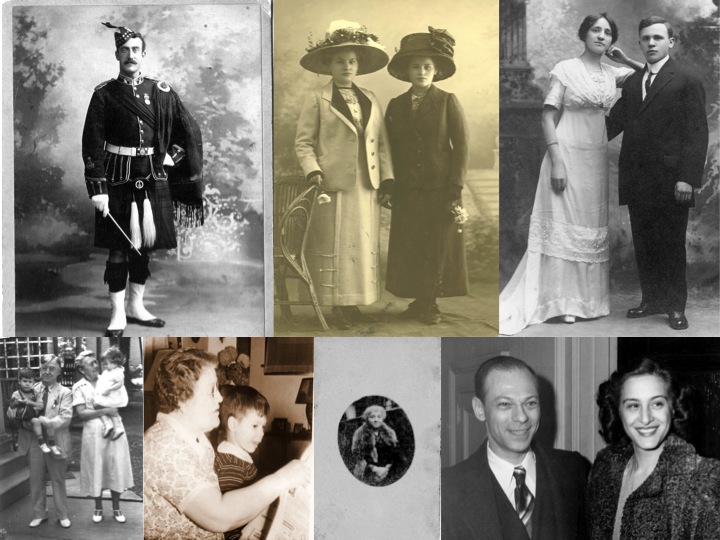
March 31, 1891 was the birthdate of my husband's 1st cousin, 1x removed: Charles Francis Elton Wood (1891-1951). Charles's birthdate is on both of his wartime draft records and on his death cert.
The son of a painter, Charles was a farmer originally. Then he went to work as a baker for the Jersey Bread Company in Toledo, Ohio. He continued to work as a baker until he died, suddenly and tragically, in the fall of 1951, as a result of a traffic accident in Salt Lake City.
But Charles has a second family connection on the tree. His mother-in-law, Carolina "Carey" Foltz Cragg (1871-?), became my husband's step-grandma for nearly a decade by marrying James Edgar Wood (1871-1939) in 1928. The marriage was arranged by the families to put widowed Carey together with widowed/divorced James in Jackson, MI. By the time Grandpa James died in 1939, however, he was living in Cleveland, OH, and Carey was not with him. Did she die first? Still searching for her death info. Not April fooling, either.
This post was inspired by Randy Seaver's prompt of "which ancestors were born on this date" for his Saturday Night Genealogy Fun.
Adventures in #Genealogy . . . learning new methodology, finding out about ancestors, documenting #FamilyHistory, and connecting with cousins! Now on BlueSky as @climbingfamilytree.bsky.social
Pages
- Home
- Wm Tyler Bentley story
- Isaac & Henrietta Birk's story
- Abraham & Annie Berk's Story
- Farkas & Kunstler, Hungary
- Mary A. Demarest's story
- Rachel & Jonah Jacobs
- Robt & Mary Larimer's story
- Meyer & Tillie Mahler's story
- McClure, Donegal
- Wood family, Ohio
- McKibbin, Larimer, Work
- Schwartz family, Ungvar
- Steiner & Rinehart
- John & Mary Slatter's story
- MY GENEALOGY PRESENTATIONS
Sunday, April 1, 2018
Thursday, March 29, 2018
History Gets Personal in Family History
Everyone's family history is influenced by (and can influence) the course of history. That's what makes history so personal in our family's history.
I'm struck by this again and again as I transcribe letters written by Farkas cousins to the family tree association during WWII. These cousins were in the service (some in the US Army, some in Army Air Corps, some in Navy, some in WAC) and their letters home are filled with observations that bring history alive and illuminate how the war experiences affected them personally. The letters also reveal personality and, often, a dry sense of humor.
Above, the letterhead from a cousin's letter written in January, 1943. Notice the words running along the ribbon at bottom of the image--"Prepare for Combat."
Cousin G enlisted to fly but he couldn't land the way the Army Air Force wanted, he wrote home in a 1942 letter. At that point, he chose to train as a navigator/bombardier.
In this 1943 letter, written from an Army Air Field in Monroe, LA, cousin G is "waiting around for shipment to Advanced [training] which will be in Coral Gables, Florida." He mentions that the school is run by Pan-American (Airways) and he has to satisfy a tougher standard. Why does he care which school he attends?
I'm struck by this again and again as I transcribe letters written by Farkas cousins to the family tree association during WWII. These cousins were in the service (some in the US Army, some in Army Air Corps, some in Navy, some in WAC) and their letters home are filled with observations that bring history alive and illuminate how the war experiences affected them personally. The letters also reveal personality and, often, a dry sense of humor.
Above, the letterhead from a cousin's letter written in January, 1943. Notice the words running along the ribbon at bottom of the image--"Prepare for Combat."
Cousin G enlisted to fly but he couldn't land the way the Army Air Force wanted, he wrote home in a 1942 letter. At that point, he chose to train as a navigator/bombardier.
In this 1943 letter, written from an Army Air Field in Monroe, LA, cousin G is "waiting around for shipment to Advanced [training] which will be in Coral Gables, Florida." He mentions that the school is run by Pan-American (Airways) and he has to satisfy a tougher standard. Why does he care which school he attends?
"The main reason I decided upon the Gables was that most of the navigation is over water and from what I hear that is pretty important when you have to pick an island out of the whole Pacific."Cousin G understands that he has a role to play in history and takes it seriously, even when his letters make the family smile. His role in history affects his family history too, and I'm proud to document what he wrote to the family during these critical years. Plus I'm learning more about historical details as I add explanatory endnotes to the letters, ensuring that future generations will get the full picture of our family's contributions to and experiences in World War II.
Labels:
#familyhistory,
Army Air Force,
Farkas,
Farkas Family Tree,
World War II,
WWII
Monday, March 26, 2018
Three Sites Are Better Than One: Finding Uncle Joe in the Census?
Family Search, Heritage Quest, Ancestry each indexes federal and state Census records independently. If one site doesn't seem to turn up an ancestor in a Census, always--always!--try the other two. Between the three sites, I've learned where most of my ancestors were during a Census period.
This week, I was looking at the timeline gaps in my research into the early life of Uncle Joseph A. Markell (1895?-1975). For some reason, he didn't show up in Ancestry when searching the 1905 New York State Census, so I tried Family Search. Immediately, a Joseph Markell popped up. In a very unlikely setting, I might add. The name and the age are what I expected, not the place. Is this the right person?
As shown in the NY Census excerpt at top, a Joseph Markell was age 12 and living at boarding school in 1905, at the Weingart Institute.
What was this school all about? I located several references. Here's a reference from an 1893 handbook to NYC, explaining that this school was K-12, including college prep.

Another mention of this school was in a NY Times ad from 1908. In both of the references, the Weingart Institute's gymnasium was a selling point. One more online search turned up a piece about this school's summer camp in Highmount, NY--a camp attended by young Oscar Hammerstein, among other luminaries.
Where exactly the money came from to send Joseph to a posh private school is quite a mystery, which is why I have to dig deeper to be sure this is MY family's Joseph. So far, I haven't located the whereabouts of Joseph's parents in 1905. Very possibly they weren't living together; she could have been in PA while he was in NYC. I say this because I know Joseph's mother, Rosa Lebowitz Markell, died young in 1909 in Allegheny county, PA. I have her death cert and this is definitely the right Rosa.
That left his father, "Barney" Benjamin Isaac Enoch Markell (1874-1944), who was working as a "driver" in 1902 in NYC, according to his citizenship papers, responsible for Joseph. Both Barney and son Joseph were living in Rosa's mother's NYC apartment, according to the 1910 Census (found on all three sites).
Once Barney remarried in 1914, however, Joe didn't get along with his new step-mom and left as soon as he could. By the time of the US Census in 1920, Joe was in the Navy, a yeoman serving on the U.S.S. Niagara off Tampico, Mexico. In 1921, he was out of the service and married to Mary Mahler (1896-1979). The newlyweds first settled in New York City, later moving to New Rochelle, just north of the city.
Their neighbors around the corner in New Rochelle were Rose Farkas Freedman (1901-1993) and her husband, George M. Freedman (1900-1989). Rose, my mother's aunt, and her neighbor Mary Markell (my father's aunt) were BFFs . . . and they introduced my parents to each other. The rest is #familyhistory! Now to round out the stories, I'll be looking more closely at Uncle Joe and the possibility that he went to private school in 1905. And where his parents were at the time....?
This week, I was looking at the timeline gaps in my research into the early life of Uncle Joseph A. Markell (1895?-1975). For some reason, he didn't show up in Ancestry when searching the 1905 New York State Census, so I tried Family Search. Immediately, a Joseph Markell popped up. In a very unlikely setting, I might add. The name and the age are what I expected, not the place. Is this the right person?
As shown in the NY Census excerpt at top, a Joseph Markell was age 12 and living at boarding school in 1905, at the Weingart Institute.
What was this school all about? I located several references. Here's a reference from an 1893 handbook to NYC, explaining that this school was K-12, including college prep.

Another mention of this school was in a NY Times ad from 1908. In both of the references, the Weingart Institute's gymnasium was a selling point. One more online search turned up a piece about this school's summer camp in Highmount, NY--a camp attended by young Oscar Hammerstein, among other luminaries.
Where exactly the money came from to send Joseph to a posh private school is quite a mystery, which is why I have to dig deeper to be sure this is MY family's Joseph. So far, I haven't located the whereabouts of Joseph's parents in 1905. Very possibly they weren't living together; she could have been in PA while he was in NYC. I say this because I know Joseph's mother, Rosa Lebowitz Markell, died young in 1909 in Allegheny county, PA. I have her death cert and this is definitely the right Rosa.
That left his father, "Barney" Benjamin Isaac Enoch Markell (1874-1944), who was working as a "driver" in 1902 in NYC, according to his citizenship papers, responsible for Joseph. Both Barney and son Joseph were living in Rosa's mother's NYC apartment, according to the 1910 Census (found on all three sites).
Once Barney remarried in 1914, however, Joe didn't get along with his new step-mom and left as soon as he could. By the time of the US Census in 1920, Joe was in the Navy, a yeoman serving on the U.S.S. Niagara off Tampico, Mexico. In 1921, he was out of the service and married to Mary Mahler (1896-1979). The newlyweds first settled in New York City, later moving to New Rochelle, just north of the city.
Their neighbors around the corner in New Rochelle were Rose Farkas Freedman (1901-1993) and her husband, George M. Freedman (1900-1989). Rose, my mother's aunt, and her neighbor Mary Markell (my father's aunt) were BFFs . . . and they introduced my parents to each other. The rest is #familyhistory! Now to round out the stories, I'll be looking more closely at Uncle Joe and the possibility that he went to private school in 1905. And where his parents were at the time....?
Sunday, March 25, 2018
Easter Greetings in Family History
By following the addresses and dates on holiday postcards sent to young Wallis W. Wood (1905-1957) in Cleveland, Ohio, I can see where the family was living and when, and who was staying in touch. Above, a beautiful penny postcard sent to Wallis by his aunt Nellie (Rachel Ellen Wood Kirby) and uncle Arthur Kirby in Chicago for Easter in 1914. Wallis was my husband's uncle.
"Aunt Nellie" was, it seems, the favorite sister of Wallis's father, James Edgar Wood (1871-1939). They remained close as adults and his children received many postcards from this beloved aunt.
James Edgar Wood's oldest son, Edgar James Wood (1903-1986), grew up and married Marian Jane McClure (1909-1983) in Cleveland in 1935. Above, an Easter-time photo of Marian at age 4 (as inscribed on the back--let me thank the ancestors for captioning!).
As an only child, she was cherished by her parents, Floyda Steiner McClure (1878-1948) and Brice Larimer McClure (1878-1970). After Marian married Ed, he became close to her parents and they had a good relationship all of their lives.
Honoring the memory of my husband's ancestors as Easter approaches and writing down their family history for future generations to know and enjoy!
"Aunt Nellie" was, it seems, the favorite sister of Wallis's father, James Edgar Wood (1871-1939). They remained close as adults and his children received many postcards from this beloved aunt.
James Edgar Wood's oldest son, Edgar James Wood (1903-1986), grew up and married Marian Jane McClure (1909-1983) in Cleveland in 1935. Above, an Easter-time photo of Marian at age 4 (as inscribed on the back--let me thank the ancestors for captioning!).
As an only child, she was cherished by her parents, Floyda Steiner McClure (1878-1948) and Brice Larimer McClure (1878-1970). After Marian married Ed, he became close to her parents and they had a good relationship all of their lives.
Honoring the memory of my husband's ancestors as Easter approaches and writing down their family history for future generations to know and enjoy!
Wednesday, March 21, 2018
The "Write" Way to Write Family History
That's the "write" thing to do.
Maybe you feel you're not a writer or you haven't done enough research or you need more details or photos. Please keep in mind that as the keeper of the family history, you know more than your relatives. And your relatives and heirs don't expect Shakespeare--they will be delighted just to find out who their ancestors were!
Doing the "write" thing is, in fact, an excellent way to identify gaps in research and missing leaves on the tree. If something is wrong or incomplete (incorrect spelling, inaccurate dates, missing details), you can always fix it later. Really.
Case in point: In 2012, I printed a small photo book about my parents' wedding, which united the Burk and Schwartz families. The main purpose was to reprint the many family photos with captions, for the sake of future generations. Cousins helped me identify nearly everyone in every photo. But there were some "unknowns" and I simply called them that in the captions (see above). Better done than perfect.
Fast-forward to 2017, when I smashed a brick wall and found second cousins who--wonder of wonders!--are descendants of the "unidentified cousins" in the photos. Needless to say, I immediately hand-wrote the new names into my printed photo book. Remember, the goal is to share family history with future generations, not to have an immaculate book. Earlier this year, when I saw a big sale, I reprinted the original photo book with corrections and additions.
So go ahead and do the "write" thing. Some ideas to get you in the "write" mood:
- Pick a person or a surname or an occasion, spread out your research, and jot notes you can then flesh out into sentences and paragraphs. I wrote about one set of grandparents at a time, since their lives were intertwined, but I had a separate page or two about birth/early childhood of each individual.
- Pick a photo and list the people in it. Then write a bit about each person and the relationships between some or all. Include what you know about where and when, or other details to "set the scene" for descendants who never knew these people. I found some photos so evocative that the words poured out almost faster than I could type.
- Ask your audience (children or nieces/nephews or any other readers) who or what they'd like to know about. My family asked for a booklet about Mom and her twin sister. I'm making notes already. My sis-in-law wants a book about her parents. I'm scanning photos in preparation.
You don't have to start at the beginning as you write. Sometimes the best way to get yourself going is to begin with something dramatic or humorous or characteristic of the person. My blog posts often serve as a rough draft of a family history booklet.
There's no one "write" way to write family history. You can write one page about one person, or a pamphlet about a couple, or a book about a family. You might decide to tell the stories in photos with captions, rather than using a lot of text. The important thing, as I said at the beginning, is to start writing. Enjoy the journey, and your family will enjoy what you write.
Subscribe to:
Comments (Atom)