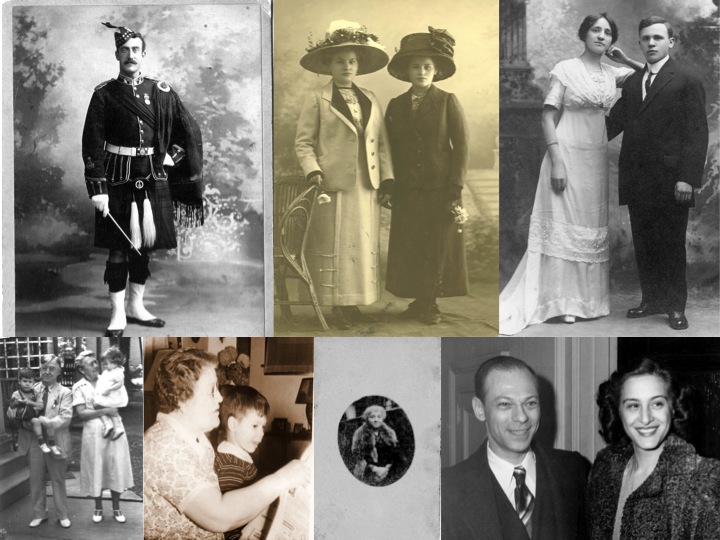
My great-grandma Leni Kunstler Farkas (1865-1938) was the prototypical strong immigrant woman. Just look at her, posing for a photo in the mid-1930s, and you can see her determination.
Until I read Immigrant Women in the Land of Dollars, I didn't realize that Leni's strong-willed matriarchal tactics were typical of immigrant women running households in the Lower East Side of New York City.
Leni (Americanized as Lena) married Moritz Farkas (1857-1936) in Hungary. They raised a family of 8 children while he leased land and supervised farming. When Moritz's crops were destroyed by hail in 1899--the one year he failed to buy insurance--he escaped his creditors by sailing on the S. S. Spaarndam to New York City, leaving wife and children behind with her mother.
After a year, Leni sailed alone to New York to be with Moritz. Four of their children joined them a year later, and the remaining four were finally reunited with their family 18 months after that--having been forced to wait for forged documents so the boys could avoid conscription in Hungary.
In America, Leni and Moritz had three more children, making a grand total of 13 mouths to feed. Finding herself in a dollar economy rather than a farming community where barter was common, Leni had to find a new way forward for the family.
Leni was a strict disciplinarian, giving orders, assigning chores, and tolerating no backtalk. She sent the older children out to find work and made sure they went to night school to learn English; the youngest attended P.S. 188 on Lewis and Houston streets. On payday, she demanded the pay packets from all her working children and handed back some nickels for carfare (bus or subway) plus a bite of lunch. The older boys got some carefare but had to walk home many days.
Leni's husband, Moritz, had weak lungs; he found work intermittently as an apple peddler and a presser. As a result, the children's wages were needed to cover household expenses. Still, there were some years when Leni put aside enough cash to vacation by herself in the Catskills for two or three weeks during the stiflingly hot New York City summers!
The family thrived under Leni's control and as the children grew up, married, and had children of their own, all returned to Leni and Moritz's on a regular basis. The children formed the Farkas Family Tree to continue their close-knit relationships. The patriarch and matriarch were honorary members. Every March after Leni and Moritz died, the family tree would hold a moment of silence in their memory--a tradition started by my grandpa Tivador Schwartz, who married Leni and Moritz's oldest daughter.
This post honors my great-grandma as a strong woman, the focus of week 10 in Amy Johnson Crow's #52Ancestors series. And a big thank you to my Cousin B, who began collecting family stories and cranking microfilmed Census records more than 20 years ago! She saved the memories of her mother's generation and now I'm passing them along to the next generation via my blog and in many other ways.
Adventures in #Genealogy . . . learning new methodology, finding out about ancestors, documenting #FamilyHistory, and connecting with cousins! Now on BlueSky as @climbingfamilytree.bsky.social
Pages
- Home
- Wm Tyler Bentley story
- Isaac & Henrietta Birk's story
- Abraham & Annie Berk's Story
- Farkas & Kunstler, Hungary
- Mary A. Demarest's story
- Rachel & Jonah Jacobs
- Robt & Mary Larimer's story
- Meyer & Tillie Mahler's story
- McClure, Donegal
- Wood family, Ohio
- McKibbin, Larimer, Work
- Schwartz family, Ungvar
- Steiner & Rinehart
- John & Mary Slatter's story
- MY GENEALOGY PRESENTATIONS
Sunday, March 11, 2018
Friday, March 9, 2018
Where There's a Will, There's a Family Reunion (in Venice)
Last week's #52Ancestors challenge (#9 in the series by Amy Johnson Crow) was "Where there's a will..." Since I was at RootsTech then, I'm catching up on my regular genealogy blogging now. My husband suggested today's post, about the wonderful way that a will turned into a family reunion.
Hubby's granddaddy, Brice Larimer McCLURE, was born on Dec. 29, 1878 (in Little Traverse, Michigan) and died on Dec. 15, 1970 (in Cleveland, Ohio). He passed away just shy of his 92nd birthday.
Brice's will left his only child, my late mother-in-law, Marian McClure WOOD (1909-1983), a bank account with a modest four-digit balance.
Marian decided to take that money and treat her three children (and spouses) and three grandchildren to a trip to Venice. Her favorite city in the world!
Since the three children were scattered across the country, this trip was both a family reunion and an opportunity to experience Venice together, paid for by Brice's legacy.
Marian and her husband, Edgar James WOOD (1903-1986) were also big fans of trans-Atlantic cruises. The photo above is one of many cruise photos that Marian and Ed took during their yearly travels to Europe after he retired.
For the reunion trip, they booked passage on the S.S. France, Cabin P252, from New York to Southampton. (Ed was a prodigious diarist, writing a few lines every day for more than 30 years--that's how I know who/what/when/where.)
Ed and Marian and their children arrived in Venice starting on September 6, 1972, and did some sightseeing together for a week. Afterward, everyone scattered to visit other European destinations on their own, their flights home also paid for by Brice's legacy.
This year, I'm creating a family memory booklet with photos from that delightful Venice trip and comments from hubby, his siblings, and the youngsters who played with pigeons in Saint Marks Square (now grown with children of their own). That's one of the many ways* I'm helping to keep the family's history alive for future generations to enjoy!
--
*For more ideas, please check out my genealogy book, Planning a Future for Your Family's Past, available in paperback or Kindle.
Hubby's granddaddy, Brice Larimer McCLURE, was born on Dec. 29, 1878 (in Little Traverse, Michigan) and died on Dec. 15, 1970 (in Cleveland, Ohio). He passed away just shy of his 92nd birthday.
Brice's will left his only child, my late mother-in-law, Marian McClure WOOD (1909-1983), a bank account with a modest four-digit balance.
Marian decided to take that money and treat her three children (and spouses) and three grandchildren to a trip to Venice. Her favorite city in the world!
Since the three children were scattered across the country, this trip was both a family reunion and an opportunity to experience Venice together, paid for by Brice's legacy.
Marian and her husband, Edgar James WOOD (1903-1986) were also big fans of trans-Atlantic cruises. The photo above is one of many cruise photos that Marian and Ed took during their yearly travels to Europe after he retired.
For the reunion trip, they booked passage on the S.S. France, Cabin P252, from New York to Southampton. (Ed was a prodigious diarist, writing a few lines every day for more than 30 years--that's how I know who/what/when/where.)
Ed and Marian and their children arrived in Venice starting on September 6, 1972, and did some sightseeing together for a week. Afterward, everyone scattered to visit other European destinations on their own, their flights home also paid for by Brice's legacy.
This year, I'm creating a family memory booklet with photos from that delightful Venice trip and comments from hubby, his siblings, and the youngsters who played with pigeons in Saint Marks Square (now grown with children of their own). That's one of the many ways* I'm helping to keep the family's history alive for future generations to enjoy!
--
*For more ideas, please check out my genealogy book, Planning a Future for Your Family's Past, available in paperback or Kindle.
Wednesday, March 7, 2018
Found: Farkas Family WWII Letters
In 2013, I first learned about the existence of written records covering most meetings of my mother's Farkas Family Tree stretching from 1933 through 1964. This family-tree association, which met 10 times a year, consisted of all the adult children (and their spouses) of patriarch Moritz FARKAS and matriarch Lena KUNSTLER Farkas. I remember attending meetings when I was a tiny tyke, but of course I had no idea of the elaborate administrative framework created by the family.*
Once a cousin kindly let me borrow the meeting minutes and annual historian's reports, I scanned all 500 pages. Then I indexed and identified each person as a relative/in-law (by relationship) or as a family friend. Indexing helped me solve several family mysteries!
However, the World War II meeting notes were mostly missing, as were letters written by family members who were in the service during the war. Five years I've tried to find these missing documents, with no luck. I feared they were lost forever.
Until a lucky break last month. I reconnected with a 2d cousin, who mentioned his search for some of the minutes and records I'd scanned. And lo and behold, he has in his possession the missing family-tree minutes and letters from the war years!
We swapped. Now I'm scanning (and indexing) all the new-found minutes and letters from the 1940s. At top, the title page of the scrapbook he lent me. At right, a letter written by my Auntie Dorothy Schwartz exactly 75 years ago this month--when she was a WAC in training, prior to being posted overseas for World War II service.
Lucky, lucky me to be able to assemble a complete set of minutes and letters for the Farkas Family Tree and keep them safe for the next generation (and beyond).
Thanks to Elizabeth O'Neal for the Genealogy Blog Party prompt "As luck would have it" for March.
*One of Mom's first cousins had bound books of meeting minutes and documents and when he and I got together for the first time in decades, and I began to ask him about the family, he casually mentioned having those books. I then volunteered to scan and produce a spiral-bound book. He thought it would take me years. It took less than 3 months, including indexing, because another cousin volunteered to retype anything that was illegible. So remember: Always reach out to cousins and let them know of your interest in anything even vaguely related to family history!
Once a cousin kindly let me borrow the meeting minutes and annual historian's reports, I scanned all 500 pages. Then I indexed and identified each person as a relative/in-law (by relationship) or as a family friend. Indexing helped me solve several family mysteries!
However, the World War II meeting notes were mostly missing, as were letters written by family members who were in the service during the war. Five years I've tried to find these missing documents, with no luck. I feared they were lost forever.
Until a lucky break last month. I reconnected with a 2d cousin, who mentioned his search for some of the minutes and records I'd scanned. And lo and behold, he has in his possession the missing family-tree minutes and letters from the war years!
We swapped. Now I'm scanning (and indexing) all the new-found minutes and letters from the 1940s. At top, the title page of the scrapbook he lent me. At right, a letter written by my Auntie Dorothy Schwartz exactly 75 years ago this month--when she was a WAC in training, prior to being posted overseas for World War II service.
Lucky, lucky me to be able to assemble a complete set of minutes and letters for the Farkas Family Tree and keep them safe for the next generation (and beyond).
Thanks to Elizabeth O'Neal for the Genealogy Blog Party prompt "As luck would have it" for March.
*One of Mom's first cousins had bound books of meeting minutes and documents and when he and I got together for the first time in decades, and I began to ask him about the family, he casually mentioned having those books. I then volunteered to scan and produce a spiral-bound book. He thought it would take me years. It took less than 3 months, including indexing, because another cousin volunteered to retype anything that was illegible. So remember: Always reach out to cousins and let them know of your interest in anything even vaguely related to family history!
Labels:
Farkas,
Farkas Family Tree,
indexing,
Kunstler,
Schwartz,
World War II,
WWII
Friday, March 2, 2018
RootsTech Day 3: Scott Hamilton, British Gen, Jurisdictions, and Blogging Connections
Well, it's a few minutes after my figure skating hero, Scott Hamilton, concluded his emotional talk about family and connections. Here he is with a photo of the parents who adopted him, and a brother and sister. No dry eyes in the audience as he told of his life's journey so far. He received a preview of what genealogical research revealed about his birth parents. Can't wait to learn more later.
Maybe there were a few empty seats in the ballroom but I didn't see 'em. Above, a small part of the massive crowd streaming out after Scott's inspiring talk.
After Scott, my first session was the ever-dapper Myko Clelland, offering tips for finding "Hidden Gems in FindMyPast's British & Irish Collections." Despite a technical glitch with his slides, the talk was practical and informative, of course. He just happened to show a record set that might help me break a brickwall on hubby's Slatter side! Top takeaways: Use the A-Z Catalog to locate records, filter by country, use the unique search screens to find record sets by entering as little as possible and then adding more info (dates, for instance, or address) to narrow.
During the break, I caught up with David Allen Lambert, chief genealogist of American Ancestors.
Then the lunchtime Geneabloggers Tribe group photo was a hoot and a fun opportunity to see so many blogging buddies in one place at one time. Above, with permission, is the "composite" photo with a few Geneabloggers magically added via technology. I'm the small sardine in the middle of the front row, a few shoulders away from Thomas MacEntee.
My afternoon sessions began with Laurie Castillo's "Search All the Jurisdictions" presentation. She knows so much about shifting state/county/township jurisdictions and how to figure out where our ancestors lived when they were alive. That's where we need to look for the records. Her advice: Don't assume anything. Do the research and use maps, gazetteers, whatever it takes to figure out what a place was when our ancestors lived there and then look for the repository holding those records.
Alas, I was crowded out of Amy Johnson Crow & Curt Witcher's talk, as well as shut out of Shannon Christmas's DNA talk. Happily, I squeezed into "What's Next? Turning British Clues into Answers" taught by the terrific Amy Harris.
This was pure methodology at its best. Her case study for finding Mr. Freak (his name, really!) was a perfect way to see the Genealogical Proof Standard in action. Oh, and in the next few days, BYU will be launching its redesigned site for British genealogy.
Try this URL early next week: Englishancestors.byu.edu. I can't make it a hotlink because it's not yet live. Just copy and paste into your browser for lots of goodies.
PS If you're at #RootsTech, don't forget to click on the clipboard to rate each speaker and session. They really want our feedback! Bye-bye from SLC. It's been quite a memorable week.
Maybe there were a few empty seats in the ballroom but I didn't see 'em. Above, a small part of the massive crowd streaming out after Scott's inspiring talk.
After Scott, my first session was the ever-dapper Myko Clelland, offering tips for finding "Hidden Gems in FindMyPast's British & Irish Collections." Despite a technical glitch with his slides, the talk was practical and informative, of course. He just happened to show a record set that might help me break a brickwall on hubby's Slatter side! Top takeaways: Use the A-Z Catalog to locate records, filter by country, use the unique search screens to find record sets by entering as little as possible and then adding more info (dates, for instance, or address) to narrow.
During the break, I caught up with David Allen Lambert, chief genealogist of American Ancestors.
Then the lunchtime Geneabloggers Tribe group photo was a hoot and a fun opportunity to see so many blogging buddies in one place at one time. Above, with permission, is the "composite" photo with a few Geneabloggers magically added via technology. I'm the small sardine in the middle of the front row, a few shoulders away from Thomas MacEntee.
My afternoon sessions began with Laurie Castillo's "Search All the Jurisdictions" presentation. She knows so much about shifting state/county/township jurisdictions and how to figure out where our ancestors lived when they were alive. That's where we need to look for the records. Her advice: Don't assume anything. Do the research and use maps, gazetteers, whatever it takes to figure out what a place was when our ancestors lived there and then look for the repository holding those records.
Alas, I was crowded out of Amy Johnson Crow & Curt Witcher's talk, as well as shut out of Shannon Christmas's DNA talk. Happily, I squeezed into "What's Next? Turning British Clues into Answers" taught by the terrific Amy Harris.
This was pure methodology at its best. Her case study for finding Mr. Freak (his name, really!) was a perfect way to see the Genealogical Proof Standard in action. Oh, and in the next few days, BYU will be launching its redesigned site for British genealogy.
Try this URL early next week: Englishancestors.byu.edu. I can't make it a hotlink because it's not yet live. Just copy and paste into your browser for lots of goodies.
PS If you're at #RootsTech, don't forget to click on the clipboard to rate each speaker and session. They really want our feedback! Bye-bye from SLC. It's been quite a memorable week.
Thursday, March 1, 2018
RootsTech Day 2: DNA Again, Photo Clues, Parish Chest, Expo Encore
On Day two of my very first-ever RootsTech, a real highlight was catching up with Devon Noel Lee and Randy Seaver just before his guest appearance at her Family History Fanatics booth. I read their blogs all the time for ideas and inspiration.
My first breakout session was Tim Janzen's excellent and timely "Update to 3rd Party Autosomal DNA Analysis Tools." Lots of new news. He recommends that we try Gedmatch Genesis for more detailed matching/analysis tools and compatibility with key testing companies. Also he noted DNA Painter won an innovation here at RootsTech (I haven't used it yet but I liked what he showed as a sample). So many good tips, I haven't got room here. Just know that our genetic genealogy toolkits are expanding every week!
Next, I walked out of a session that I won't name, because the speaker spent loads of time on background and didn't get to the point even after 12 minutes. This is something I really don't like doing, but RootsTech time is valuable and scarce. I did use the feedback tool on the app to express my opinion. Enough said.
After lots of fun in the Expo Hall (buying RootsTech sox, a sparkly gen T-shirt and of course DNA kits), my afternoon began with Maureen Taylor's interactive session, "No Language Barrier: Immigrant Clues in Photos." I always like her talks, and this was enjoyable and motivating. She reminds us to look carefully at fashions and hairstyles, also see what ancestors are holding (a photo or a book for instance), see what clues are in the background, think about why the photo was taken, and research the photographer. We had a good time guessing on many photos, and helped Maureen with a few new interpretations/translations, too.
The final session of the day for me was "Finding Your Way Around the Parish Chest" with not one, not two, but three expert speakers: Kirsty Gray, Sylvia Valentine, and Patricia Whatley. Learned a lot at this talk--starting with how much info is available if ancestors were paupers (yes, I'm talking about hubby's Slatter ancestors). Often the parishes would try to hand paupers off to other parishes rather than bear the expense of keeping them going. Will have to look for more paperwork in the parish chests!
My first breakout session was Tim Janzen's excellent and timely "Update to 3rd Party Autosomal DNA Analysis Tools." Lots of new news. He recommends that we try Gedmatch Genesis for more detailed matching/analysis tools and compatibility with key testing companies. Also he noted DNA Painter won an innovation here at RootsTech (I haven't used it yet but I liked what he showed as a sample). So many good tips, I haven't got room here. Just know that our genetic genealogy toolkits are expanding every week!
Next, I walked out of a session that I won't name, because the speaker spent loads of time on background and didn't get to the point even after 12 minutes. This is something I really don't like doing, but RootsTech time is valuable and scarce. I did use the feedback tool on the app to express my opinion. Enough said.
After lots of fun in the Expo Hall (buying RootsTech sox, a sparkly gen T-shirt and of course DNA kits), my afternoon began with Maureen Taylor's interactive session, "No Language Barrier: Immigrant Clues in Photos." I always like her talks, and this was enjoyable and motivating. She reminds us to look carefully at fashions and hairstyles, also see what ancestors are holding (a photo or a book for instance), see what clues are in the background, think about why the photo was taken, and research the photographer. We had a good time guessing on many photos, and helped Maureen with a few new interpretations/translations, too.
The final session of the day for me was "Finding Your Way Around the Parish Chest" with not one, not two, but three expert speakers: Kirsty Gray, Sylvia Valentine, and Patricia Whatley. Learned a lot at this talk--starting with how much info is available if ancestors were paupers (yes, I'm talking about hubby's Slatter ancestors). Often the parishes would try to hand paupers off to other parishes rather than bear the expense of keeping them going. Will have to look for more paperwork in the parish chests!
Subscribe to:
Comments (Atom)


