Wednesday, June 8, 2022

1950 US Census: Indexed by Computers, Reviewed by People


Released on April 1, the 1950 US Census is available to browse and search for free on Ancestry and Family Search (among other sites, including the US National Archives). For more about this mid-century American Census, see the informative Family Search page here. Also take a peek at the Family Search YouTube Channel playlist of 1950 Census videos.

Indexed by computers, reviewed by people

Family Search describes the 1950 Census as "indexed by computers, reviewed by people." 

Ancestry used artificial intelligence to create an "early index," already available on that site. Still, computers invariably make mistakes, which is where the "reviewed by people" part comes in. 

Ancestry turned the index over to Family Search, which has recruited thousands of volunteers to review the names, checking that the digital index actually reflects what the handwritten name says on the Census page.

Volunteers are also reviewing households to see whether all people in that household have been grouped properly by the AI indexing system, and be sure the main details are correct.  

Progress! See the webinar on June 10

By the end of June, every name in the 1950 US Census index on Family Search will have been reviewed by human eyes! That's a real plus for finding our ancestors through a name search, rather than the browsing method of looking at one page at a time.

For the latest from Family Search, you can watch a webinar update on Friday, June 10, at 4 pm Mountain Time. 

Here's the link--and you don't need to be a Facebook member to watch! 

Tuesday, June 7, 2022

Fixing a Mistaken Assumption by Buying a Record


Albert Winkler was my first cousin, once removed, the nephew of my maternal grandfather, Theodore Schwartz. His mother, Rezi Schwartz Winkler (1881-1944) was my grandpa's oldest sister.

I know Albert's name because he submitted Yad Vashem testimony about the Holocaust killings of his mother and other close relatives. But I knew almost nothing else about him, other than he died in May of 1993. 

Don't assume anything!

Without any proof, I made the assumption that Albert was born in the early 1900s, given that his parents Rezi and Moritz Winkler were married in 1898 and their children began arriving in 1899. At this point, the youngest child I'd found was Lili Winkler, who was born on March 20, 1912

Traditional sources didn't help me much in my research for Albert. Then I took a look at summaries of birth records available for purchase from the specialized site Sub-Carpathia Genealogy

Doing a record search on this site for "Winkler" birth records from Ungvar (now Uzhhorod, Ukraine), I found TWO Winkler children born in March, 1912. 

Father of both: Mor Winkler. Mother's maiden name of both: Schwartz. One baby Winkler was named Lili, the other baby Winkler was named Bela. A Winkler cousin confirmed that Bela was almost certainly Albert.

Paying to fix my mistake

Of course I quickly clicked to buy the records for Bela Winkler. Within an hour I had proof that he was born on March 20, 1912, the same day as his twin sister, Lili Winkler! (Twins run in the Schwartz family, by the way. Bela and Lili had twin first cousins, my Mom and her twin sister.)

As soon as I plugged in this birth date for Albert Bela Winkler (using Ancestry, MyHeritage, and FamilySearch), I had multiple results.

Never, in a million years, would I have been able to find out so much without paying for this unique record to get Bela's original name and exact birth date. Why? Because Bela had yet another name!

Bela, Albert, Voytech

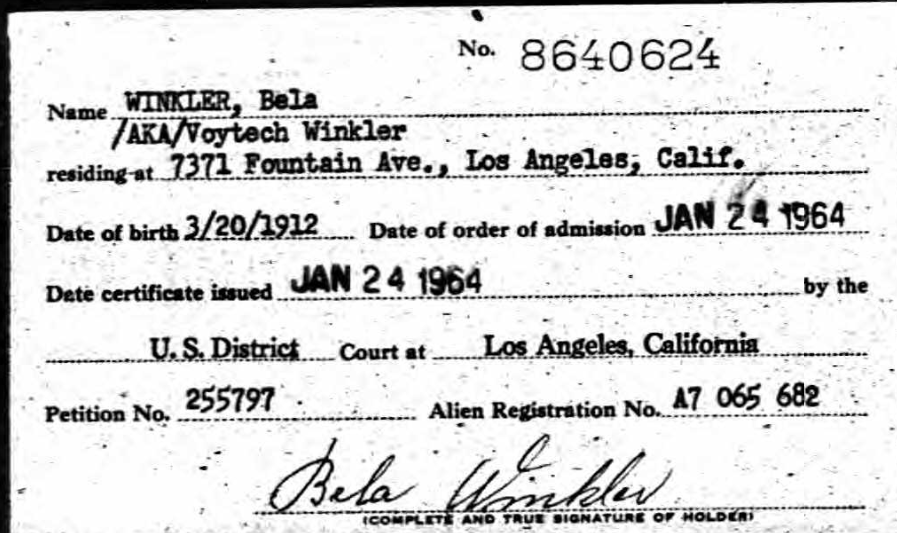
As shown at the top of this post, Albert entered the United States under the name of Voytech Winkler. Not a name I've ever seen before. It only turned up once I searched for Bela Winkler with the exact birth date and residence city.

This single index card, for Albert's naturalization, gave me a wealth of information. I tracked down the passenger list, his naturalization petition, and his naturalization papers. I learned that Albert married in 1962, and his Hungarian-born wife was naturalized around the same time as Albert. There's more to discover, but already I have many more facts than I had before.

UPDATE: "Voytech" on the passenger list was phonetic...I found "Wojtek Winkler" (born in Uzhhorod) on a list of Vilna Refugees in 1940, "Polish Jewish Refugees" who had been helped out of Krakow. Now to investigate further! 

All because I invested in a unique genealogical record to fix my mistaken assumption. Now my trees show Albert Bela Winkler, 1912-1993.

--

"Mistake" is this week's #52Ancestors prompt from Amy Johnson Crow.

Friday, June 3, 2022

One Ulysses in the Family Tree


My husband's family tree has a number of ancestors apparently named after famous people in American history. Only one person in the tree was named for a general well known for his role in winning the bloodiest conflict ever on American soil. Little historical tid-bits like this help get the younger generation interested in our family's history!

Benjamin Franklin (inventor and statesman)

Two men with this name: 

    - Benjamin Franklin Steiner, 1840-1924

    - Benjamin Franklin Smith, 1794-1835

George Washington (first US President)

One man with this name:

    - George Washington Howland, 1855-before 1884

John Quincy (Adams - sixth US President)

Two men with this name:

    - John Quincy Steiner, 1862-1941 (a son of Benjamin Franklin Steiner)

    - John Quincy Steiner, 1894-1909

Thomas Jefferson (third US President)

One young man with this name:

    - Thomas Jefferson Isaiah Haskell Wood, 1848-1861

John Marshall (early Chief Justice of US Supreme Court)

One young man with this name:

    - John Marshall Taber Wood, 1850-1859

Ulysses (Grant - Union General, then US President)

The only boy in the Wood family tree named Ulysses was born just a few months after Confederate General Robert E. Lee surrendered to Union General Ulysses S Grant in 1865. Grant was later elected as the 18th US President, serving two terms from 1869 to 1877.

    - Ulysses Larimer, born on September 1st, 1865, died on August 18th, 1870. 

Little Ulysses Larimer was buried in Brown Cemetery, Millersburg, Elkhart, Indiana, with other members of his family.

--

This is my post for Amy Johnson Crow's #52Ancestors challenge, this week with the theme of "conflict."

Monday, May 30, 2022

Why I'm Staying with FindaGrave


Despite the many criticisms of FindaGrave.com, I'm sticking with it. 

There are valid criticisms, to be sure, as this post by "Legal Genealogist" Judy Russell shows. Rather than throw the baby out with the bath water and stop participating because some volunteers misuse FindaGrave, I'm choosing the other path. 

I'm doubling down to improve the memorials of ancestors and in-laws in my family tree and my husband's family tree. 

The site, now owned by Ancestry, is completely free and available worldwide. 

Not every cemetery on the planet is represented, and certainly not every burial site or columbarium. 

Still, FindaGrave has long been a convenient site for me to memorialize ancestors, link relatives to other family members, and create virtual cemeteries so I can share with my own family. It's genealogy but it's also a whole lot more.

On Memorial Day and Veterans' Day, I like to leave virtual flowers or flags on the  memorial pages of ancestors (mine and hubby's) who served in the military, honoring their memory and service. 

Above, three generations of my husband's Larimer cousins who served their country, one in the Union Army, one in World War I, and one in the Korean and Vietnam Wars.

All were memorialized on FindaGrave by other volunteers who took the time to photograph grave stones and list the names. Picking up from there, other volunteers (including me) have linked these men to their spouses, parents, and children, and in some cases, written bite-sized bios to add more detail about their lives. 

In my view, virtual memorials help keep alive the names of these ancestors and make info about their burial places (and their lives) discoverable for anyone doing a search. 

For me, this is a great way to share family history now and to publicly show my respect for those who came before me. That's why I'm staying with FindaGrave, despite the ongoing and quite valid criticisms and definite need for improvement. I will also add my voice to the chorus letting Ancestry know about the need to take action and address misuse of its FindaGrave platform.

Thursday, May 26, 2022

Yearbook Photos of Ancestors Who Served in the Military

This is a combination post for Memorial Day 2022 and for this week's #52Ancestors prompt of "yearbook," honoring two ancestors who served during World War II.

My Aunt, the WWII WAC 

My aunt, Dorothy Schwartz (1919-2001), served overseas as a US Army WAC in World War II. 

Dorothy and her twin sister Daisy Schwartz (my Mom, 1919-1981) graduated from James Monroe High School in the Bronx, New York, in January of 1936. 

This was the same south Bronx high school attended by their older brother Frederick (see below).

When World War II broke out, Auntie Dorothy was attending Hunter College in Manhattan. 

She enlisted in the Women's Army Corps on September 11, 1942, and later was promoted to become Sgt. Schwartz (see photo at right). 

Dorothy was awarded the Bronze Star for "meritorious service in direct support of operations against the enemy." Back in civilian life, she finished college, went to work, then returned to school for education courses and became a high school teacher.

My Uncle, the WWII Army Teacher

My uncle, Frederick Schwartz (1912-1991), graduated from James Monroe High School in the Bronx, New York, in June of 1928. He was only 16.

He worked part-time as he went to college, aiming to become a high school teacher.

By the time Uncle Fred was drafted into the US Army on Nov 10, 1943, he was teaching at Stuyvesant High School in New York City. He was also married with a baby just a few months old.

Following basic training, much of Fred's three years in the US Army was devoted to teaching. At the end of the war, he held classes teaching soldiers how to navigate the Army system to receive benefits and apply skills to civilian life. 

I dedicate this post to my aunt and uncle, with affection and gratitude for their service.

Tuesday, May 24, 2022

Open Mic Night: Challenges Faced by Genealogy Groups


Friday night's #GenChat on Twitter was an open mic hour of chat about genealogy and family history and related topics. 

One tweet kicked off a spirited conversation that has continued with additional comments posted for several days, and from multiple countries:

Does anyone else who volunteers with a historical & genealogical society struggle to find volunteers? I have been volunteering at a society for 4 years now as trustee and they have not gained any new volunteers.

This is not a new challenge, to be sure. During the pandemic period in particular, some groups are struggling while others have tried to adapt to remain relevant in a changing world. Lots of groups have had this conversation internally. #GenChat's discussion was impromptu, not structured and has attracted additional tweeted comments in recent days.

During the wide-ranging discussion, some tweets mentioned an entrenched "old guard" of officers unwilling to try new ideas. Other tweets observed that younger people often don't feel welcomed by older members. Still other tweets noted the need for new blood and new outreach techniques. 

You can read most of the comments by looking for #GenChat hashtag on Twitter, with posts dated May 20 and later. Some posts don't have the hashtag, so here are an even dozen representative comments about the challenges of keeping genealogical and historical society groups alive and well. 

Tweets from the discussion

"...Sometimes there is problem of “old heads” running off “newbies” — refusing to try new ways or ideas — or just not relinquishing reins where they should. Great way to kill an org."

"It is worlds easier to collaborate and help from a distance than ever before! (Whether that distance is across the country or just across town.) But too many genealogy societies insist on not trying anything new."

"At the last [genealogy] fair I went to there was one group that seemed to hold everyone's attention but wouldn't talk to anyone outside the group."

"I hear from so many younger genealogists that their societies aren't welcoming. How do we bridge the gap?"

"Societies, overall, are *way* too passive in recruiting volunteers. They don’t ask specific people, nor do they have good job descriptions. “We need volunteers for XYZ project.” Ok, but what will they *do* and what skills and time commitment are required?"

"Common issue. Many [genealogy groups] were founded at a time when working patterns were different. Today, some feel unwelcoming. I feel there will be big changes in the next few years. Some will go, some will merge, experiments with different platforms. Big societies and hyper local ones."

"My local society has trouble finding volunteers for committee chairs and the board officers but [people] are willing to volunteer for one-off jobs all the time." 

"I think some may be somewhat hostile to trying new things too, i.e. using social media to promote themselves and get the word out about their organization. I remember seeing a family history society that had ZERO social media presence."

"A lot to learn from attachment theory. People feel attached to what they have, changing it elicits a grieving process which people try to avoid because it is painful. How do we acknowledge and work through it?" 

"If a society is trying to draw members only through programming, they’re doomed. Instead, they need to show why they are unique, why they are *valuable* to the public. They go broad, when they should be going deep."

"Unique and value are the key words. Some "deep" specialized societies have great member resources not just interesting programs. Some "broad" clubs demonstrate value via networking, mentoring, more. Need to articulate real benefits to attract people & volunteers."

"Maybe not enough people understand the importance of knowing and preserving their history. They need to understand their history connects them to the global world."

What do you think? 

This is a huge topic, and while the #GenChat hour only scratched the surface, it got people thinking and commenting about challenges and opportunities.

Please join the conversation by leaving a comment on my blog or by tweeting using the hashtag #GenChat so we can all read and chime in!
Sunday, May 22, 2022

1950 US Census Hints: Filter by Name


In the weeks since Ancestry.com began delivering 1950 US Census hints to my family trees, I've been enjoying the convenience of reviewing and adding this information to ancestor profiles.

By now, there are LOTS of hints. The default hint arrangement is by most recent hint added to my list.

But at this point, I'm being choosier about who I want to see first.

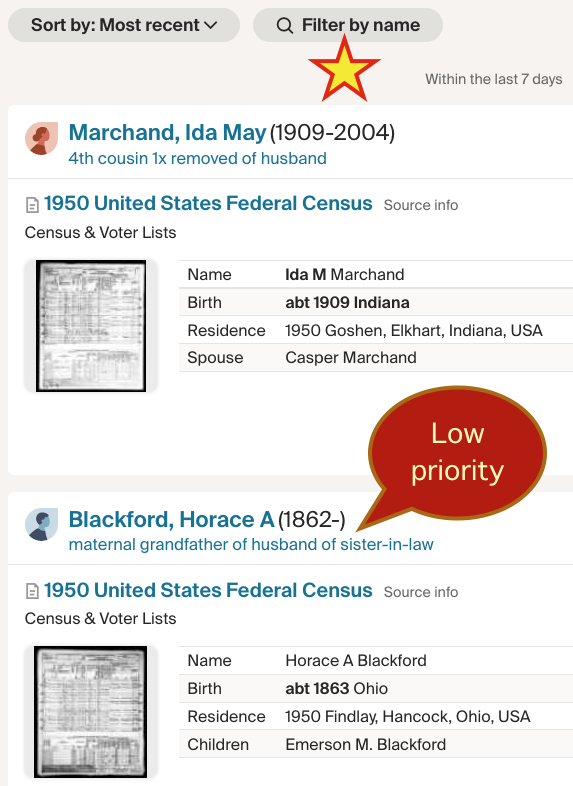
As shown above, Blackford is a recent addition to my hint list, but a low priority because the relationship is quite distant. Maternal grandfather of husband of sister-in-law! Not a high priority.

To see more of the people I care more about, I'm going to filter my 1950 US Census hints by name (see star at top). Then I can specify the closer ancestors I want to see first (see image below).

Filter by first name or last name or both

Later, I'll go back and review the remaining hints for distant ancestors.

Hope you're having fun finding ancestors and the FAN club (friends, associates, neighbors) in the 1950 Census. 

Thursday, May 19, 2022

What's Wrong with This Picture?

One of the most famous gravestone typos of all time is on a stone at the Old Mission Cemetery in Upper Sandusky, Ohio. 

My hubby's grandparents are buried in Old Mission (Brice Larimer McClure and Floyda Steiner McClure), which is how we happened to see and photograph the headstone shown here.

Can you spot the mistake?

The Find a Grave memorial for Christiana Haag offers more info here.

In my family tree, the headstone for a great uncle shows an incorrect date--a discrepancy I discovered when I obtained his death cert. 

This stone with a typo is a great reminder: Even if a name, date, or age is "carved in stone," we still need to check and confirm!

This photo is, as my friend says, "a grave mistake."