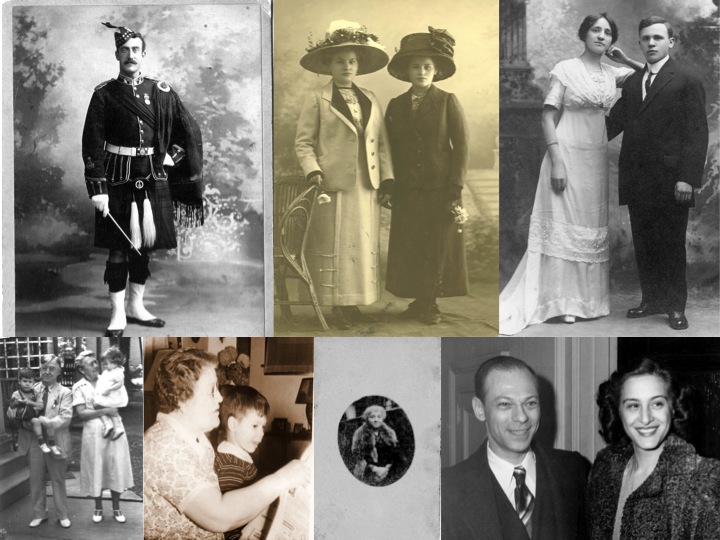
Thursday, May 12, 2016

Free the Faces on Slides to Unlock Family Stories

Do you, like me, have binders or boxes filled with 35mm slides?

Think of all those faces and stories trapped on those teeny, tiny slides. Some of my big breakthroughs in genealogy have come when a cousin recognized a face in a photo and dredged up an old family story. If those little faces don't escape from the slides, family stories may not come to light.

My late father-in-law, Edgar James Wood, had a dozen slide trays filled with travel images. Others in the family stored slides in binders (see above). These slides were not only dated, they had a table of contents with each binder and notes about where/why the photos were taken. A great head start for family history research!

However, it's not a good idea to leave slides in these plastic sleeves for decades, unless they're archival quality. Even then, remember that slide technology is old technology.

How many of our descendants will have or want a slide projector? I have one spare projector bulb. In 15 or 50 years, will another bulb be available if a grandchild or great-great-grandkid wants to view slides? Probably not. Will they even know what a projector was??

So it's time to downsize, move to newer technology, and organize.
  • Decide what to save, then toss or give away the rest. With apologies to my dad-in-law, 95% of his slides were of unknown landscapes, well-known world landmarks, grass or sky--we tossed those. We saved the 5% of slides with people and/or recognizable homes/rooms.  
  • Transfer the slides to digital images. We digitized nearly everything and filed them digitally by surname. We printed some images to blow up and share with the family, adding full printed captions to the hard copies. Keep the technology up to date, switching away from CDs to USBs and the cloud, or whatever is the latest.
  • Share the images. Printing allowed us to show photos to relatives who helped figure out who was who. It was fun to blow up a couple of slides of holidays in the old homestead, which would never have been seen again if they were trapped in 35mm slide technology.
  • Caption, caption, caption. While relatives can still remember who's who and when slides or photos were taken, write the captions now. Store captions with printed photos and/or write up the captions and file by surname, referring to digitized images and their location in the cloud or on a DVD or wherever.
Free the faces and unlock those family stories!

Wednesday, May 11, 2016

Wordless Wednesday: Wood's Society Syncopators

This banner, on velvet, dates from hubby's father's career playing jazz piano during and after college in the jazz era of the mid-1920s.

Who were the Society Syncopators? Well, originally, Fate Marable's Society Syncopators popularized jazz on Mississippi riverboats during the 1920s--most likely the inspiration for Edgar James Wood using a similar name for his jazz band or trio.

Sweet Sue and Her Society Syncopators were the band in 1959's Some Like It Hot, which is set in 1929.

Monday, May 9, 2016

Military Monday: It's a Long Way to Tipperary WWI Handkerchief

Hubby's grandma, Mary Slatter Wood (1869-1925), kept this handkerchief from World War I. Someone wrote "World War 1914" in pencil at bottom right and then, just in case that wasn't enough, permanently inked "World War 1914" at bottom right. (Mary's Shehen grandparents were born in Ireland but she and her parents were born in England.)

Mary most likely received this from one of her bandmaster brothers in Canada, Captain John Slatter of the 48th Highlanders in Toronto or Henry Arthur Slatter of the 72d Seaforth Highlanders in Vancouver or Albert William Slatter of the 7th London Fusiliers in Ontario.
 It's a Long Way to Tipperary was popular during WWI, and troops were heard singing it all over Europe.

I did a little Web research and discovered this exact handkerchief in the collection of London's Imperial War Museum! And in other museums, including Museum Victoria in Australia and the Canadian War Museum.

The medal is the Victoria Cross.

Saturday, May 7, 2016

Happy Mom's Day to Two Much-Missed Moms

A loving tribute to two loving moms.

At left is my Mom, Daisy, about age 20. She graduated high school at 16 but instead of going directly to college, she worked to help her siblings through college.

At right is hubby's Mom, Marian, about age 48. She was a talented ceramicist and enthusiastically supported all her children's artistic endeavors.

My Mom's parents were from the Farkas and Schwartz families. My mom-in-law's parents were from the McClure and Steiner families. Thinking of these Moms and the Moms in their families on Mother's Day.

Wednesday, May 4, 2016

In Loving Memory on Holocaust Remembrance Day

Both of the ladies in this photograph, dear sisters of my grandpa Theodore Schwartz, lost their lives in the Holocaust. On Yom HaShoah, I want to honor their memory and the lives of so many others who were killed by saying:

Never forget. Never again.

Saturday, April 30, 2016

Remembering Li'l Sis

Remembering all the good times. Miss you, li'l sis.

Wednesday, April 27, 2016

"Uncle Joseph Roth" Links the Wajman and Weiss Families

For two years, I've been searching for the link between the Weiman family, Roth family, and Weiss family. My Roth cousins knew they were related to the Weiman family, and vice versa. But how? And we all wondered how my Roth cousins are related to me!

Part of the answer was on page 2 of a passenger manifest showing Hersch Wajman, wife Ida, and daughter Magda, sailing from Liverpool on the "Carmania" on 18 February 1921 and arriving in New York City on 28 February 1921.

On line 6, shown above, Hersch (Herman) Wajman (later Weiman) said the family was going to "Uncle Joseph Roth" at an address in New York City--an address that appears on Joseph Roth's passport application. This is an exact match for the Joseph Roth who was the brother-in-law of my great-grandma, Lena Kunstler Farkas.

It's complicated--Joseph Roth's brother was Bela Roth, and Bela's first wife was Zalli Kunstler (sister of Lena, my ggm). Gets even more complicated: Bela's second wife was Batia Bertha Weiss.

If you're still with me, the maiden name of Hersch/Herman Wajman/Weiman's wife was Ida Julia Weiss, known as Julia. We have other Weiss in-laws in my Farkas family, some who are married to Roths.


I did a search for Herman and Julia's young daughter Magda, who arrived at Ellis Island as a one-year-old, and this turned up a second manifest. The family was originally booked to sail from London to Boston on the "Saxonia" on 17 February 1921, arriving on 2 March 1921. They were crossed off that passenger list, as shown above. How and why the Weiman family switched from the port of London to the port of Liverpool and chose to land in New York instead of Boston, I just don't know.

The manifest is readable enough to be sure this is the correct Wajman/Weiman family. Hersh named his mother, "K Wajmann" as the nearest relative in Opatow, Poland, where he was from. Hersh was a watchmaker who spoke Polish, Russian, Yiddish, and Hungarian.

On page 2 of the "Saxonia" manifest, not shown here, the family says they're going to join--"Uncle Joseph Roth," a manufacturer, at his business address in New York City. MY Joseph Roth!

Wait, there's more: Julia Weiss Weiman's Soc Sec application lists her parents as Isador Weiss and Fany Roth. So "Uncle Joseph Roth" appears to be Julia's uncle. Therefore: Joseph Roth's children are first cousins of Julia Weiss Weiman, and Joseph Roth's grandchildren are second cousins of Julia's children. Now we know!

Next, I'm going to look for Julia's siblings/parents and also try to learn more about Batia Bertha Weiss's siblings. If there's any overlap, then as they say in Britain, "Bob's your uncle." Or, in this case, "Joseph's your uncle."