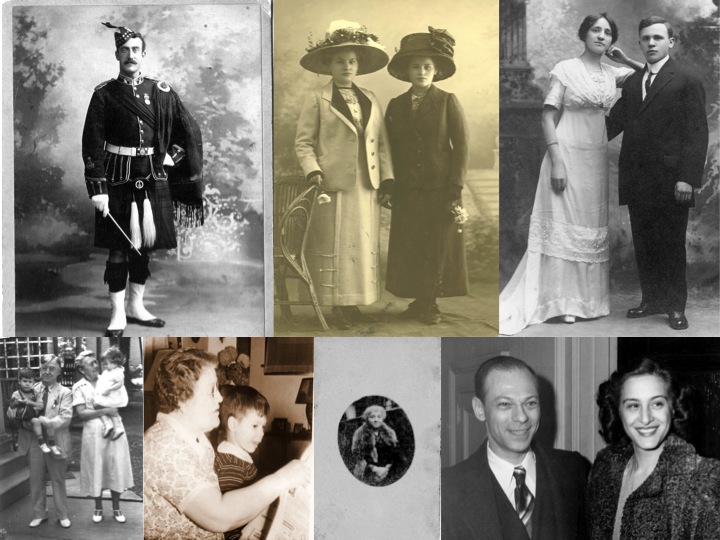
When the 1950 US Census is released in April, 2022, I won't just be looking at who and where--I'll be studying all the answers provided by my ancestors and comparing them to national statistics for the period. This puts my ancestors into context. Income is a good example.
National Statistics: Median US Income in 1949
According to the above map, based on results in the 1950 Census, the median income for 1949 reported by respondents to the Census was $2,619.
The map also shows the handful of states where median income was higher than this national average--and the many states where the median income was lower than this national average.
Many of my ancestors lived in New York in 1950, so I expect that if any were asked the supplemental questions about income, they will answer with above-average earnings. My husband's ancestors were in Ohio, which as a state also shows above-average earnings.
Were My Ancestors Above or Below the Median?
Based on my mother's recollections, my father's earnings in 1949 were well above this national median. If I'm lucky, he will have answered the supplemental questions asked of 20% of the US population in 1950, so I can compare with the median figure.
A self-employed travel agent, my father's business was doing very well during the post-war period. In fact, he could barely keep up with demand for train and plane tickets. Then again, his business was based in a luxury hotel across the street from the world-famous Plaza Hotel in New York City. Well-heeled guests sought out his services to arrange itineraries for trips near and far.
Want to read more about the 1950 Census? See the summary of my series on this page.
Adventures in #Genealogy . . . learning new methodology, finding out about ancestors, documenting #FamilyHistory, and connecting with cousins! Now on BlueSky as @climbingfamilytree.bsky.social
Pages
- Home
- Wm Tyler Bentley story
- Isaac & Henrietta Birk's story
- Abraham & Annie Berk's Story
- Farkas & Kunstler, Hungary
- Mary A. Demarest's story
- Rachel & Jonah Jacobs
- Robt & Mary Larimer's story
- Meyer & Tillie Mahler's story
- McClure, Donegal
- Wood family, Ohio
- McKibbin, Larimer, Work
- Schwartz family, Ungvar
- Steiner & Rinehart
- John & Mary Slatter's story
- MY GENEALOGY PRESENTATIONS
Friday, January 17, 2020
Thursday, January 16, 2020
Census Day Bounced Around, and So Did Some Ancestors
![]() |
| From 1950 Census of Population: Vol. 2 (https://www.census.gov/library/publications/1953/dec/population-vol-02.html) |
In 2020, Census Day will be April 1st. This is not April Fool!
But Census Day hasn't always been April 1st. I try to keep this in mind when looking for my ancestors in earlier Census years.
- As shown in the excerpt above, Census Day was originally not a fixed date but taken on the first Monday in August.
- In the mid-19th century, Census Day was changed to June 1.
- In 1910, Census Day became April 15.
- In 1920, Census Day became January 1.
- Only in 1930 was Census Day fixed as April 1, where it remains.
As the excerpt indicates, two-thirds of the US population was counted by mid-April in 1950. By month's end, 90% of the population was counted.
However, "unfavorable weather conditions" in some areas delayed enumeration as late as mid-May. Finally, by the end of June, 99% of the US population was counted. I'll be sure to check the enumeration date on each ancestor's record when the 1950 Census is released in April of 2022.
From a broader perspective, the 1950 Census reflected major post-war trends in population shifts. The map above shows that four states experienced population loss. All others increased population--with the greatest growth on the West Coast, plus Florida, Virginia, and Michigan.
As I chart my ancestors' whereabouts in the 1940s to prep for the 1950 release, I need to consider how many might have moved elsewhere after World War II. There are at least a few who went west to California. Dear ancestors, you can run, but you can't hide. I hope!
For more posts about the 1950 US Census, see my summary page here.
Wednesday, January 15, 2020
Extra Notations and Detailed Answers in 1950 US Census
![]() |
| Excerpt from 1950 US Census Enumerators' Manual |
Whether enumerators for the 1950 US Census actually followed the rules set forth in the instructions, I don't yet know. But if they did, we genealogists will be glad for their extra notations and detailed answers.
Some examples:
- If the enumerator can't get a specific, accurate age from a household respondent, he or she was instructed to "enter an estimate as the last resort, and footnote it as an estimate." Wonder whether my Great-grandma Tillie Jacobs Mahler told the truth about her age? She tended to fudge a year or two in either direction.
- If the enumerator thinks an answer is not truthful, he or she should footnote it and indicate what the truthful answer might be. Wouldn't that be interesting to see on a page with my ancestors? Looking at Great-grandma Tillie, would the enumerator believe she was, say, 98? I can't wait to find out.
- Asking about the respondent's occupation, enumerators are not to accept a general term like "agent" or "clerk" or "engineer" but must ask questions to obtain more specifics, such as "purchasing agent" or "aeronautical engineer." This would help me learn a bit more about ancestors whose work lives I know little about.
- Enumerators were to be specific about the county in which the respondent lived a year before. This will be really valuable to me, because instructions say not to accept merely "New York City" but ask about the specific borough of the city. If my ancestors moved from, say, Brooklyn to the Bronx in 1949-50, this question may reveal the move. I'm talking about you, Great-aunt Nellie Block!
Monday, January 13, 2020
What Future Genealogists Will Learn from the 2020 US Census
![]() |
| Page 1 of the 2020 Census questionnaire |
![]() |
| Page 2 of 2020 Census |
One key piece of info is the month, day, and year of birth for each person in the household, to be entered on page 2 of the Census questionnaire.
Future genealogists will be able to look for a birth cert, compare with age shown on other documents, match someone to a marriage license or other vital record, and so on--with more confidence because they will have the complete birth date, not just "age" or birth month and year.
I was surprised but interested to learn that another question (on page 1) is about whether a person in the household (1) owns the residence clear and free of a mortgage, (2) has a mortgage, or (3) is not paying rent. Clues to seeking deeds, taxes, and other records!
![]() |
| 2020 Census questions about usual residence and relationship to head of household |
Look at the many answer alternatives shown in the excerpt above!
These two questions will elicit incredibly valuable information for future genealogists. Question #2 will point toward where the person's usual residence is (such as with another relative or in the military). Question #3 will tell, with great precision, how each person is related to the head of the household--clues to filling in gaps in the family tree!
Future genealogists, there may not be many questions on the 2020 Census form, but there will be several top-quality clues to be followed up. Yes, I'm going to answer the Census as fully and completely as possible. You'll be able to find me and my family in 72 years, I promise.
Saturday, January 11, 2020
1950 US Census: "Think Like an Enumerator"
![]() |
| 1950 US Census manual |
My prep for this Census release includes understanding what the enumerators were instructed to do (and not do).
I'm browsing through the Urban & Rural Enumerator's Reference Manual so I can . . . "Think Like an Enumerator." (You can read the manual here.)
Enumerators were told, for example, that if no one was home at time of their visit and that household was expected to be away for some time, talk with a neighbor and record as much detail as possible. Then add the notation: "Information given by a neighbor."
Now, 72 years later, we should take such information with a grain of salt because it was not first-hand. How many neighbors can recite the proper age or birth year for anyone or everyone in my household? None. Same holds true for 1950, even though neighbors might have been living near each other for many years. But I'm happy that the Census will contain such notations to alert us to be cautious in accepting the information as factual.
![]() |
| Enumerator instructions on p. 10 of 1950 Census manual |
Be aware that 1950 Census enumerators were instructed to visit residences in a particular order and to ask neighbors where houses were located, so they wouldn't miss any. Read more on the U.S. National Archives blog here.
P.S.: I'm putting all of my 1950 Census blog posts into one summary page, with header found at top of my blog. The direct link is here. Thank you for reading!
Subscribe to:
Comments (Atom)


