Sunday, May 22, 2022

1950 US Census Hints: Filter by Name


In the weeks since Ancestry.com began delivering 1950 US Census hints to my family trees, I've been enjoying the convenience of reviewing and adding this information to ancestor profiles.

By now, there are LOTS of hints. The default hint arrangement is by most recent hint added to my list.

But at this point, I'm being choosier about who I want to see first.

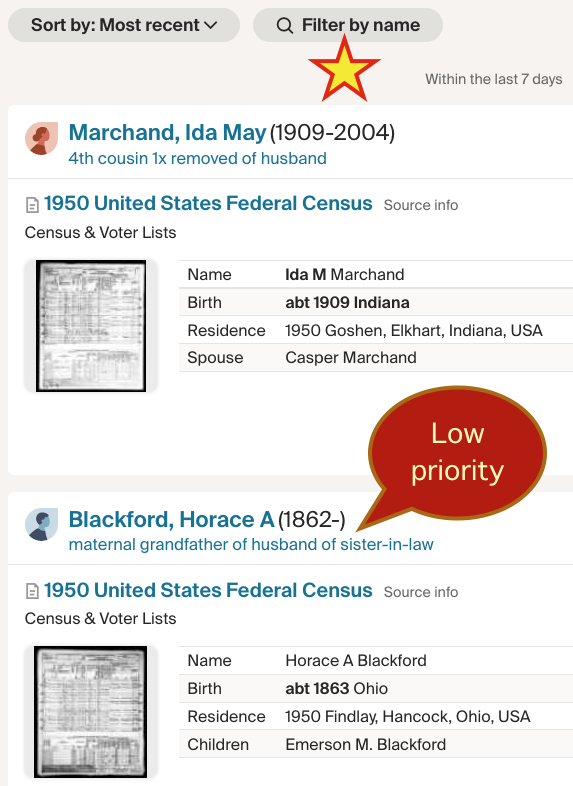
As shown above, Blackford is a recent addition to my hint list, but a low priority because the relationship is quite distant. Maternal grandfather of husband of sister-in-law! Not a high priority.

To see more of the people I care more about, I'm going to filter my 1950 US Census hints by name (see star at top). Then I can specify the closer ancestors I want to see first (see image below).

Filter by first name or last name or both

Later, I'll go back and review the remaining hints for distant ancestors.

Hope you're having fun finding ancestors and the FAN club (friends, associates, neighbors) in the 1950 Census. 

Thursday, May 19, 2022

What's Wrong with This Picture?

One of the most famous gravestone typos of all time is on a stone at the Old Mission Cemetery in Upper Sandusky, Ohio. 

My hubby's grandparents are buried in Old Mission (Brice Larimer McClure and Floyda Steiner McClure), which is how we happened to see and photograph the headstone shown here.

Can you spot the mistake?

The Find a Grave memorial for Christiana Haag offers more info here.

In my family tree, the headstone for a great uncle shows an incorrect date--a discrepancy I discovered when I obtained his death cert. 

This stone with a typo is a great reminder: Even if a name, date, or age is "carved in stone," we still need to check and confirm!

This photo is, as my friend says, "a grave mistake."

Tuesday, May 17, 2022

Curating and Sharing Old Family Photos


This week I've been moving "old" family photos into archival photo albums. The ultimate goal is to encourage relatives to page through the albums now and then.

Currently, I'm sorting and arranging hundreds and hundreds of snapshots from the more recent past--meaning 2010 back through the 1960s. I'm saving the very oldest photos for last, because I'll be using a different kind of photo album for those odd-sized prints.

Happily, most of the photos have the month and year of development auto-printed on the back (as shown at top, left) or on the front border. This is a big help in sparking memories about who, what, when, where, and why, for captioning purposes.

There are a LOT of near duplicate photos, for a very good reason. In the pre-digital age, we would often take two or even three photos of the same person or scene, because we weren't always sure which would come out well (if any). That's why there are SO many photos to reorganize into albums.

As I sort through the photos, I'm curating by:

  • Tossing out of focus or very poor quality photos, like the one at top right. 
  • Saving only one of exact double and triple prints, sending most of the dupes to relatives as a surprise.
  • Putting the best photo in the album and inserting a near-duplicate underneath the best print. The near-dupe isn't visible but it's available in the album, if I don't send one or more to relatives right now ;)
Curating doesn't take much time but it will focus attention on the most important photos from our family's past. It also means the albums will not have too many multiple versions of the near-same photo. 

Plus it's fun to share the dupes and near-dupes with relatives now--and it gets a conversation going about family history.

I may even create a few photo books with themes such as weddings, graduations, or holidays, featuring different ancestors and relatives through the years. It's another way to keep alive the memory of our ancestors, gone but not forgotten.

Saturday, May 14, 2022

Saving Family Letters for Future Generations

My aunt Dorothy Schwartz (1919-2001) was a prodigious correspondent, writing monthly letters to relatives near and far. 

I have dozens of letters and a few postcards written to one of her nieces, dating from the early 1980s and continuing until shortly before her death nearly 20 years later. 

"Auntie" wrote of life after retiring from her teaching career, about her travels, about being in touch with relatives, about her health, and more.

I found some really interesting family history tidbits in her letters. Did Dorothy's grandpa Moritz Farkas (1867-1936) play favorites? Dorothy says Moritz's oldest daughter was his favorite--even though another of Moritz's daughters insisted she was always the favorite. And that's just one example.

Put a sleeve on it

Yesterday I finished carefully unfolding and inserting each letter into a clear archival resealable sleeve, sliding the envelope in the back of each sleeve, to keep everything safe for the future. (This was long after I had removed staples, clips, and rubber bands.)

The letters, flat and straight in their sleeves, will be organized chronologically. Some don't have years, just day and month at top of the letter, and a few have no envelopes with postmarks. I'll have to "guess" the year based on what each undated letter says. At some point, I'll scan the letters but for now, I want to smooth them out and keep them safe.

Next step: For easy storage, I like to box things up.

Box things up 

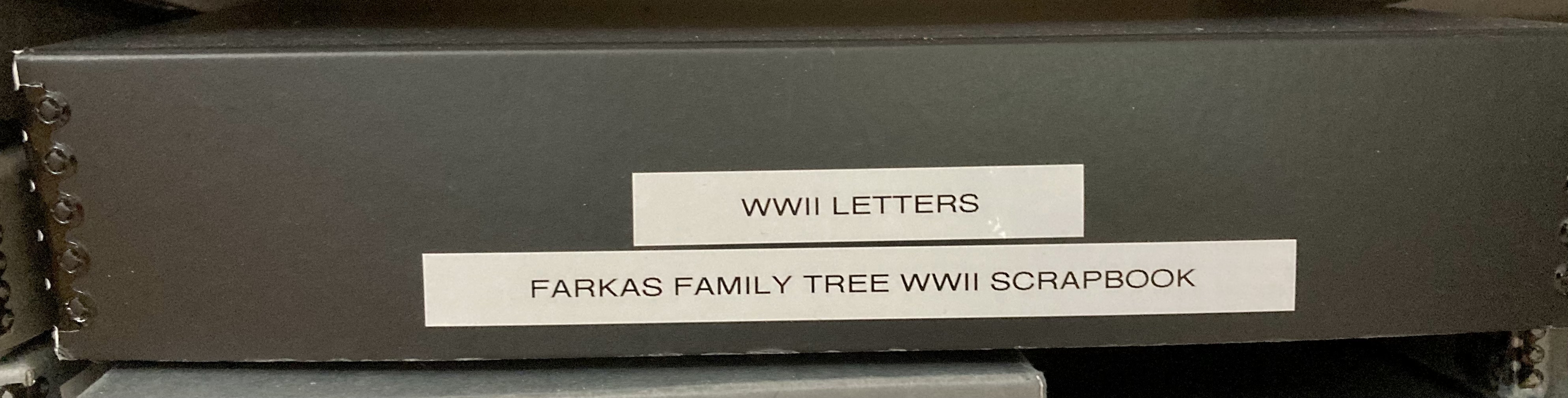
My favorite storage method is the archival box. As shown above, I buy boxes with metal corners so they can be stacked 6 high without giving way. Boxes come in a variety of sizes to fit nearly every kind of genealogical item that can lay flat, such as a document or a photo or an album or even a Bible.

I use my trusty label maker to add a descriptive label on the short side and the long side of each box, so I can read the contents no matter which side faces out.

As soon as I finish arranging my aunt's letters, that box will join the rest of the archival boxes of documents and photos in my home office--including the box above, containing letters written home during World War II by service members in my Farkas family tree. 

Transcribe for accessibility

I've previously transcribed the WWII letters and sent copies of the letters and transcriptions to my cousins, the children and grandchildren of those service members. Years ago, I transcribed letters written to my mother during the late 1940s, when she met and was courted by my father. Other letters still await transcription.

Meanwhile, the letters are safely stored and will go to designated genealogy heirs when I join my ancestors someday.

--

For more about organizing, curating, and preserving family history for the sake of future generations and future researchers, please take a look at my concise, affordable book, Planning a Future for Your Family's Past, available on Amazon, at the American Ancestors book store/catalog, and at the Newberry Library book store.

Thursday, May 12, 2022

Drool-worthy Food from Family History


When I indexed the 30 years of meeting notes from my mother's Farkas Family Tree association, I never thought to index the foods so carefully and deliciously described. Those meeting minutes have given me lots of genealogy clues and insights into family history dynamics over the years. This week, I drooled over the talk of food!

The tree (known within the family as the FFT) was formed in 1933 by the adult children of Lena Kunstler Farkas (1865-1938) and Morris Farkas (1857-1936), who left Hungary for a new life in America at the turn of the 20th century. 

Since their descendants mostly lived in the New York City area, the tree meetings provided a structure for relatives to see each other often.

Not only did the tree conduct "business," such as purchasing cemetery plots, it also served as a focal point for socializing all year. And socializing means food, right?!

From dessert to full meals

In the first year, a Depression period, only desserts were described, such as home-made cheese strudel served by my great aunt Jennie Katz Farkas (1886-1974) in December, 1933.

It didn't take very long for a little culinary rivalry to creep in. Sometimes meeting hosts and hostesses offered a big spread of delicatessen meats, cheeses and salads. Others prepared roast beef with lots of side dishes, served buffet style. 

Turkey wasn't just for Thanksgiving. Given the size of the crowd (at least 15 adults per meeting, plus their children), cooking a turkey made sense. The minutes for one meeting, echoing comments in others, say: "A bee-line was made straight for the delicious turkey, salads, and all the trimmings." 

One night late in the 1930s, when the FFT met at the apartment of my maternal grandparents, Theodore Schwartz (1887-1965) and Hermina Farkas Schwartz (1886-1964), the secretary reported in the minutes: 

"Our host and hostess for the evening, Ted and Min, rather outdid themselves in the preparation of a meal before this meeting. But the guests did the [hot] dogs--and I don't mean Skippy--justice. But we must not forget the many side dishes accompanying the dogs. Sauerkraut, potato salad, beans, and others were not spared. I am sure the guests of the evening would have preferred to sleep after that, to the "hard" work that they proceeded to put in." [Note: the actual business meeting lasted for an hour, followed by card playing "until all hours."]

War-time meetings and beyond

During World War II, rationing and food shortages forced the hosting families to change their menus, I noticed as I read through the meeting minutes. 

One hostess was "congratulated and thanked for the franks and trimmings" she served after business was concluded. How did this come about? A clue in another set of meeting minutes, when a hostess reminded relatives to please bring their ration books so they could get enough of certain foods, especially for holiday meals.

After the war, so many of the members were busy with growing families (marriages, children, grandchildren) that the FFT met less often. The tree organized a yearly summer picnic in the park or at the beach, with barbecued franks and burgers. But no more holiday meals for 50 at home. Instead, the FFT held big Thanksgiving bashes in Manhattan hotels or restaurants during the 1950s, so all members could enjoy the festivities without food prep, cooking, or cleanup.

Here's my great aunt Ella's favorite rice pudding recipe--more custard than rice. She wrote it for 6-8 servings, scaling up for the family tree crowds. She didn't note size of baking dish, probably a buttered two-quart oven-safe pan, so just experiment!

Ella's Custardy Rice Pudding

1/4 cup rice

1 TB butter

1/3 cup sugar

1 tsp salt (for water)

2 1/2 - 3 cups milk (adjust as needed)

3 eggs, well beaten

cinnamon (optional)

Directions: Heat oven to 350 degrees. Meanwhile, boil rice in a lot of salted water. Drain and place cooked rice in oven-safe deep dish. Add butter and sugar to rice, mix, and then pour at least 2 1/2 cups of milk over all, until 1" from top of dish. Mix again. Now fold eggs into mixture, very gently. Top with sprinkling of cinnamon if desired, and bake for 40 minutes. Turn off oven and leave dish in for 10 more minutes. Remove gently, cool on rack for a few minutes, serve warm or chilled.

This is my "Food and Drink" post for Amy Johnson Crow's weekly #52Ancestors prompt.