Thursday, November 28, 2019

Happy Thanksgiving - Hubby's 5 Mayflower Ancestors

Penny postal card sent to Wallis W. Wood, circa 1910
Happy Thanksgiving!

As I do every year, I'm honoring the memory of my husband's five Mayflower ancestors. Thank you to cousin Larry, the family genealogist, for uncovering these connections to the Puritans.

  • Francis Cooke 
  • Degory Priest
  • Isaac Allerton
  • Mary Norris Allerton
  • Mary Allerton
Young Mary Allerton later married Thomas Cushman of the Fortune. She was the last of the original Mayflower passengers to die, on November 28, 1699, exactly 320 years ago.

Tuesday, November 26, 2019

Steal My Family Photos--Please

Woodcut of hubby's ancestor, "stolen" by 13 other people for their family trees!


Dear cousins and possible cousins:

"Steal my family photos--please!"

And post them on your family trees so I can connect with you. Cousin bait!

Family photo of Tillie Rose Jacobs Mahler, "stolen" by others for their family trees!

If you save my publicly-posted family photos to your tree (whether it's hubby's 2d great-grandpa Benjamin McClure or my great-grandma Tillie Rose Jacobs Mahler), I can click on your profile photo, see whether we are a DNA match, look at your tree, and find out whether (and how) we're related.

Sure, some people who are not related have mistakenly claimed my photos of dead ancestors for their trees. Either I'll send a gentle private message questioning the connection or I'll post a politely-worded public comment on the photo on that tree.

You don't need my permission to "steal" a publicly-posted photo for your tree. And I don't expect you to ask permission.*

Please, just go ahead and steal my family photos . . . and lead me to our cousin connection!

This week's #52Ancestors prompt is "Thief."

*John Tew recently wrote that while he agrees with me, he also would like those who "borrow" his photos to give credit to his grandmother who so carefully and thoughtfully preserved these photos for future generations to enjoy. A lovely idea...and I do hope some of his distant relatives will do that. I'm just happy anyone saves any of my photos so I can follow the bread crumbs and find our cousin connection.

#CousinBait #Genealogy #FamilyHistory

Sunday, November 24, 2019

Finding the Dates Outside the Dash

Death record of Sarah Ann Harris Slatter Shuttleworth, 1814-1872
So much of my genealogy research and writing focuses on what happens "in the dash," meaning on the actual life an ancestor led between birth and death.

Many times, I can prove or at least guesstimate birth and death dates, and go on to research an individual's schooling, work and home locations, career, marital status, health, and other details. It's these details that really bring ancestors to life.

In the case of my husband's 2d great-grandma, Sarah Harris, I've dug up some very significant details of her life, thanks to the UK Census, her two marriages, and birth or baptism records for her children. She's the ancestor who, with her second husband, John Shuttleworth, saved one or more grandchildren from the tragedy of being sent to a workhouse or poorhouse.

(This second husband was apparently held in high esteem by the family, because one of his Slatter stepsons named his son "John Shuttleworth Slatter," which made it very easy for me to track this ancestor through records!)

What I didn't have were the dates on either side of the dash for Sarah Harris. This time I had to pay to get the info, but it was worth it!

Clues to the Dash Dates 

Quick recap: Hubby's great-great-grandma Sarah Harris married great-great-grandpa John Slatter in Oxford, England in 1832 (based on records from St. Ebbe in Oxford).

John Slatter presumably died before the 1851 UK Census, because Sarah was then shown as a widow with children, including a child of about one. That's a good clue to John's death date for the right side of his dash, which I'll be following up on shortly.

In 1862, Sarah remarried, to John Shuttleworth (according to St. Mary, Lambeth, church records). On the various UK Census documents, her age suggests a birth year between 1813 and 1816. No sign of Sarah or her second husband in the 1881 UK Census. That sent me looking in UK death indexes for the two of them. Shuttleworth was not an uncommon name, and there were a number of possibilities.

With encouragement from my UK friends during the weekly #AncestryHour genealogy conversation, I first ordered what I believed would be John's death record. In pdf format, it was delivered in a week electronically at the reasonable price of about $9. This proved that the John Shuttleworth I sought died in 1878.

However, Sarah wasn't there--although one of her sons was present at John's death, convincing evidence that I had the correct John, Sarah's 2d husband. When this son, William Slatter, got married in 1867, his mother Sarah and stepfather John Shuttleworth were the witnesses (see record below). Definitely the correct people--the late John Slatter was, in fact, a cook, and all other details agree.


Sarah's Dash Dates

My next step was to look at the most likely "Sarah Shuttleworth" deaths between 1871 and 1878. I focused on Sarah Ann Shuttleworth, who died in the first three months of 1872. I had never seen Sarah's middle name, but the death was in the correct district and county, so I sent for the pdf.

Again, the $9 was well spent IMHO: This cert arrived in less than a week. The record is shown at top of this post.

Sarah Ann Shuttleworth was 58 when she died on February 16, 1872 at 28 Gravel Lane. Her husband, John Shuttleworth, was listed as being "present at the death." Sarah died of chronic bronchitis, which she had had for 3 months.

The address where Sarah and John lived is just a few doors away from where they lived in the 1871 Census. Everything fits. This is hubby's 2d great-grandma.

Because Sarah died early in 1872, and her husband said she was 58, my calculation is that she was born in 1814.

RIP, Sarah Ann Harris Slatter Shuttleworth, 1814-1872. You, your dates, and what happened in your life ("in the dash") are now part of our family's history.
Friday, November 22, 2019

Treasured Heirlooms: Slatter Family

World War I bugle from Slatter family
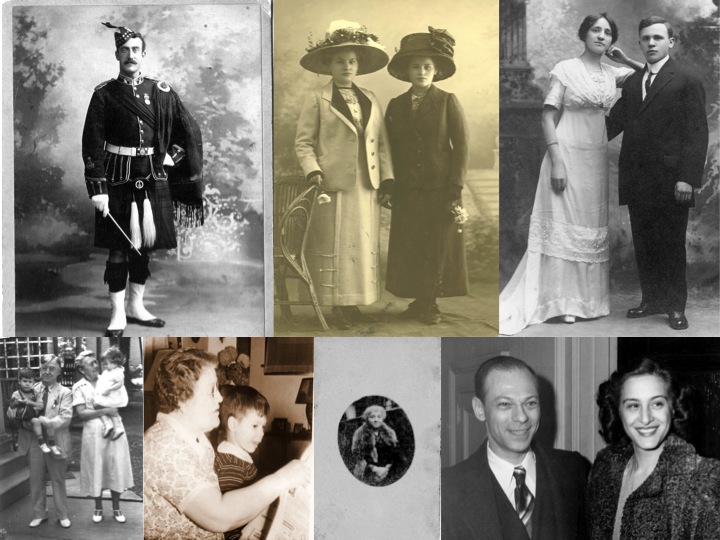
Hubby's great uncle, Captain John Daniel Slatter (1864-1954) was a renowned military bandmaster with the 48th Highlanders Regiment of Toronto. But before that, he was a very poor boy from the Whitechapel section of London, who was placed on two successive training ships on the Thames to learn military and musical skills.

At age 11, he was on H.M. Training Ship Goliath, listed as band sergeant and solo cornet of the boy's band. A few years later, he was able to enlist in the Army. Then, after a stint in the 7th Fusiliers, he married and went to Toronto, where in 1896 he was the founding director of the 48th Highlanders kiltie band. He and the band toured the world in the early years of the 20th century, popularizing the kiltie band craze and serving as proud ambassadors for the 48th Highlanders.

During World War I, Capt. Slatter was Director of Brass and Bugle Bands for Canadian Military District #2. While stationed at Camp Borden, he trained 1,000 buglers during the war years.

My husband inherited a WWI bugle that we strongly believe was Capt. Slatter's, given to his youngest sister, Mary Slatter Wood (1869-1925). She was hubby's paternal grandmother, and she left several WWI artifacts to the family. This is just one. Another is a Tipperary handkerchief that is quite well preserved, now safely stored in an archival box (inside archival tissue paper) for future generations to enjoy.

Wednesday, November 20, 2019

How Blogging Helps My Genealogy

The movements of an ancestor who caught Ohio fever
Every blog post I research and write helps my genealogy. Even after more than 11 years of blogging, and 21 years of genealogy enthusiasm, there are always new things to learn.

The process of blogging enhances my genealogy because it (1) sharpens my focus, (2) reveals gaps, and (3) serves as a rough draft of written family history.

Sharpening My Focus

Every time I blog, I narrow my focus to one ancestor, one surname, or one occasion. Or I choose one genealogical resource or method to explore. The point is to keep the focus on someone or something I can discuss in one post--a bite-sized piece of my family history.

My recent blog post about my great uncle Julius Farkas is a good example. I'm participating in Amy Johnson Crow's intriguing #52Ancestors series of weekly prompts for genealogy bloggers. For the "soldier" prompt, I decided to focus on Julius, the only conscience objector I've ever found in my family--someone who did not want to be a soldier.

Previously, I had written a few sentences about Julius in the context of others from my family who served in World War I. This time, to flesh out his story, I dug deeper into his military experience, going beyond the usual draft registration card and the summary of military service.

To my surprise, I discovered an Army transport list that had not been available when I last searched. Julius's name was the only one crossed out. The others were sent overseas into combat. With a shiver, I realized Julius would have wound up in the second battle of the Somme, had he not been reassigned at the very last minute as a Stateside Army cook. Sharpening my focus led me to this new aspect of his life.

Revealing Gaps

Gaps--yes, there are still quite a few in my family and my husband's family tree. When I blog about one ancestor or a branch of the tree, I often discover that I'm missing some information.

Take my recent two-part blog post about Mary "unknown maiden name" Shehan, my husband's ancestor who lived in London but was born in Ireland. My original intention was to try to find out where exactly she and her husband were born, and (if possible) to learn her maiden name. I wrote my blog post as I did my research.

First, I reviewed their whereabouts according to the UK census. Nowhere was any county or town listed, only "Ireland" as their birthplace. Sigh. On the other hand, there was nothing at all after 1871--a gap I needed to fill.

That's when I switched my goal to finding where and when these ancestors died. I had to dig deeper to find more documents, but ultimately I learned the sad ending to Mary "unknown" Shehan's life, unfortunately echoed in her daughter Mary Shehan Slatter's life. Blogging about these ancestors led me to discover gaps and conduct research to find out more. And it gave me crucial new insights into these ancestors' lives.

Rough Draft of Family History

Blogging allows me to "think out loud" about an ancestor or family-history situation in a post. Sometimes I write a series of blog posts about a particular topic of family, which I later turn into my first draft of a written family history.

That's what I did with my "Ohio fever" series. After reading David McCullough's well-researched book, The Pioneers, I turned my attention to three of my husband's ancestors who had caught Ohio fever. With the historical background in mind, I could understand "why," not just "when" and "where" they moved to Ohio.

With more detail and some editing, that three-post series became a seven-page booklet for the family, complete with colorful maps like the one at top. I especially wanted to grab the attention of younger relatives and show them how our family actually made history. With my blog posts as a rough draft, it was faster and easier to create the booklet than starting from scratch.

Genealogy blogging has another big benefit: It's absolutely fantastic cousin bait.

Some of my posts are brief, some are lengthy, sometimes I don't post for a week or two, but I always find blogging worthwhile and fun.