Adventures in #Genealogy . . . learning new methodology, finding out about ancestors, documenting #FamilyHistory, and connecting with cousins! Now on BlueSky as @climbingfamilytree.bsky.social
Pages
- Home
- Wm Tyler Bentley story
- Isaac & Henrietta Birk's story
- Abraham & Annie Berk's Story
- Farkas & Kunstler, Hungary
- Mary A. Demarest's story
- Rachel & Jonah Jacobs
- Robt & Mary Larimer's story
- Meyer & Tillie Mahler's story
- McClure, Donegal
- Wood family, Ohio
- McKibbin, Larimer, Work
- Schwartz family, Ungvar
- Steiner & Rinehart
- John & Mary Slatter's story
- MY GENEALOGY PRESENTATIONS
Tuesday, June 16, 2026
Whatever Happened to Henry Canner Harvey?
Saturday, May 16, 2026
Odds and Ends from Recent Genealogy Research
I've found some odd/interesting things as well as some notable "ends" in my recent family history research.
In the past few weeks, I've been surprised to learn these oddities and discoveries, sometimes from documents and sometimes from old newspapers:
- Alabama was once the quickie divorce capital of America! Based in New York City, Violet Schwartz Winton, the sister-in-law of my 1c2r, was divorced in 1958 in Alabama, of all places. Why? Only a 24-hour residency was needed for a "quickie divorce" in Alabama. Lots of famous people divorced in Alabama (millionaires, movie and TV stars, etc.). Much faster than going to Reno, Nevada.
- The 1880 US Census asks about a very broad range of illnesses and disabilities. Usually I see notations like blind or mute, but in the case of Elizabeth McCann Caldwell, wife of hubby's 1c3r, the enumerator wrote "paralyzed on right side." Elizabeth was pregnant then, and gave birth to her last child a few months later. This enumerator was very detail-oriented: she noted illnesses such as sick headache, tumor on neck, white swelling, dropsy, rheumatism, and "old age" [for anyone over 70 years old].
- Hubby's 3c1r was involved with public radio. Josephine Helen Hanford and her future husband, Raymond J. Stanley, fell in love while working at public radio station WHA in Madison during the 1930s, after both graduated from nearby University of Wisconsin. When the couple married in 1941, station co-workers attended the wedding. In 1956, Helen received a Pioneer award for writing for the station's classroom radio broadcasts.
- Grim Reaper was the headline on the column listing deaths in 1915 in the Star Press of Muncie, Indiana.
- A number of Midwestern and Southeastern US ancestors in my tree and hubby's tree died of typhoid fever, unfortunately. Outbreaks were apparently not uncommon, often due to contaminated water. My hubby's 1c3r in Missouri died of typhoid in 1911. "Typhoid may claim family" read a headline about a neighboring family stricken with typhoid weeks after this cousin died.
- "Falls Dead Sawing Wood" was the 1908 headline of a brief death notice for a farmer who died suddenly of heart disease and was found hours later still with a saw in his hand. Not a relative but a sad end.
Thursday, April 3, 2025
Two Blunt Obit Headlines for Frank Bentley Light
Researching my husband's 1c3r Frank Bentley Light (1853-1913), I was stopped dead in my tracks (so to speak) by the headlines announcing his death in Vacaville, California in 1913. The blunt language was not at all subtle but did accurately describe what happened to this man.
Above, a brief notice about "the carpenter who dropped dead" while working on a Union Ice Company building being identified as Frank B. Light. This item was picked up by the Sacramento Bee newspaper from the Vacaville newspaper. The headline "Was Frank B. Light" served as a correction because the initial report misidentified the dead man.
The full obit, which appeared on April 11, 1913 in the Vacaville Reporter newspaper, reads:
Dropped Dead. Frank B. Light Succumbs to Attack of Heart Failure. Frank B. Light, a resident of this place for a number of years, dropped dead last Friday morning while engaged in unloading a carload of ice for A.M. Stevenson. The cause of death was heart failure. Deceased was a native of Indiana and was 60 years of age. He came to California with his parents in 1853, and resided in Santa Rosa for many years before coming to Vacaville. He was a carpenter by trade and a conscientious and upright man who had the respect and esteem of all who knew him. He was unmarried and leaves a sister Mattie Light and a brother L.E. Light. The funeral was held Sunday from the Baptist church and the interment was in Vacaville cemetery.
Frank lived with his sister Martha Ann "Mattie" Light (1854-1917) for years after their parents died. She worked as a dressmaker, according to her voter registration, but it's a good guess that Frank kept a roof over their heads with his carpentry and work in lumbering and as a laborer. Vacaville was a small town when they lived there--fewer than 1,200 residents until the 1920s--and probably everybody knew everybody.
After Frank died so unexpectedly, 112 years ago this month, Mattie went to live with their brother Lucien E. Light (1862-1918), also a carpenter. Sadly, Mattie became ill and died in 1917, followed just a year later by Lucien's death. I noticed that Lucien's obit was worded more gently than Frank's obit. The headline read: "L.E. Light Passed Away Last Friday," perhaps because this death (from Bright's disease) was nowhere near as sudden as Frank's death.
"Language" is this week's #52Ancestors genealogical prompt from Amy Johnson Crow.
Wednesday, August 7, 2024
Is That a 7 or a 1? The Entire Document Tells the Story
My hubby's great-grandparents, Elizabeth Jane Rinehart (1834-1905) and Edward George Steiner (1830-1880), were married on this date in the 1850s. Elizabeth was the subject of two very nice obits after she died, full of detail with names, dates, places, background on when and where they moved.
Wednesday, July 5, 2023
Book Review: "Yours Truly"
Journalist and professional obit writer James R. Hagerty has read and written a lot of obits. In Yours Truly, he explains why and how each of us should write our own story, sooner rather than later. As Hagerty says in his intro:
"Someday the story of your life will be written. The only question is how well or how badly it will be written--what sort of picture it will leave behind for friends and family members, including those not yet born."
Every family historian who's ever researched an ancestor will appreciate the significance (even the thrill!) of discovering an obit in a newspaper or, these days, on a website. The best obits, in Hagerty's view, reveal more than just bare facts, giving a glimpse of the person's personality, attitudes, ambitions, struggles, dreams, accomplishments, and disappointments.
Yours Truly is a concise and engaging how-to book, an encouraging road map for writing a life story (whether in print or recorded). Chapter 6 includes specific questions to answer, including earliest memories, the best and worst periods of our lives, and more. "In life stories, generic will never do," Hagerty advises, because it's the details and quirks that give a real sense of the person.
Chapter 17 covers sensitive issues about honesty, with the caveat: "When you write a life story you don't have to give away all your secrets or resurrect all your family feuds." Still, the author suggests acknowledging some of our shortcomings or at least admitting when our plans didn't work out as we'd hoped.
Be sure to include historical context, such as what was happening on the day of your birth, and verify oral history, says Hagerty. His own research showed that the day he was born was cool and rainy, even though his mother remembered it as a hot summer day.
In the end, there are a variety of reasons to take the time to tell our life story, Hagerty says: "It's a way to acknowledge your failures, explain a few things your friends and family could never understand, celebrate whatever good fortune you've had, and thank those who gave you a hand or a smile when you needed it."
Yours Truly is punctuated with dozens of readable, fascinating life stories that are anything but dry and generic, whether about someone famous or an ordinary person. Readers learn how to bring life to a life story, showing a bit about what makes each person tick, with touches of vivid imagery or an unexpected last-minute twist we never see coming.
I enthusiastically recommend James R. Hagerty's book for ideas and motivation as we document the lives of our ancestors and tell the stories of our own lives.
Want to see the author interviewed about Yours Truly? Enjoy this YouTube interview conducted by Malaprop's Book store.
Saturday, January 8, 2022
Bite-Sized Bios for Earlier vs Recent Ancestors
Still, my bio for someone who died more than a century ago usually includes: birth, marriage(s), and death dates and places (where known); parents' names; spouse(s) name(s); occupations; residence(s) and land ownership; military service (if applicable); children's names; geographical movements; and some social/historical context.
Sources for writing bios of earlier ancestors
I get these details from sources such as (but not limited to) multiple Census records, vital records, military records, naturalization records, city directories, newspapers, obits, and county histories. I use Wikipedia, history books, and other sources to add a bit of background, such as about immigration trends or frontier life, when I weave the basics into an interesting story told in my own words.
Sometimes there are scant sources for a much earlier ancestor. Then I write what I can, emphasizing details that I do know--such as where that ancestor is in the birth order of siblings, how many of that ancestor's siblings survived to adulthood, what that ancestor did for a living, whether that ancestor married, and so on. These bios are not as long or rich as bios for more recent ancestors, but I do try to make them interesting and bring out the human angle.
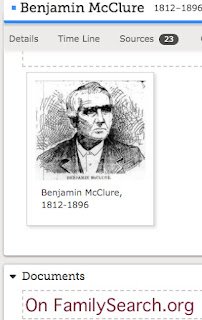
Other times, I can dig up a considerable amount of content for an ancestor who died more than a century in the past. When my husband and I were in Indiana a few years ago, we cranked a local library's microfilm reader to research ancestors in 19th century newspapers. There we found a wonderfully detailed obituary for hubby's 2d great-grandfather, Benjamin McClure (1812-1896)--a truly great source for an ancestor bio!
The woodcut portrait of Benjamin McClure, shown at top, is also from a 19th century newspaper accessed via microfilm at that same local library.* I've posted the woodcut on FamilySearch and other sites where I post bios and images, to bring this ancestor to life.
*About copyright: The Legal Genealogist, Judy Russell, writes about copyright and newspapers from time to time--including this old but still informative post. Also see this brief Library of Congress post about newspaper databases. Note that I'm not an expert on the legalities of newspapers/books and copyright, so please do your own homework before using any published content, either words or images, from the past!