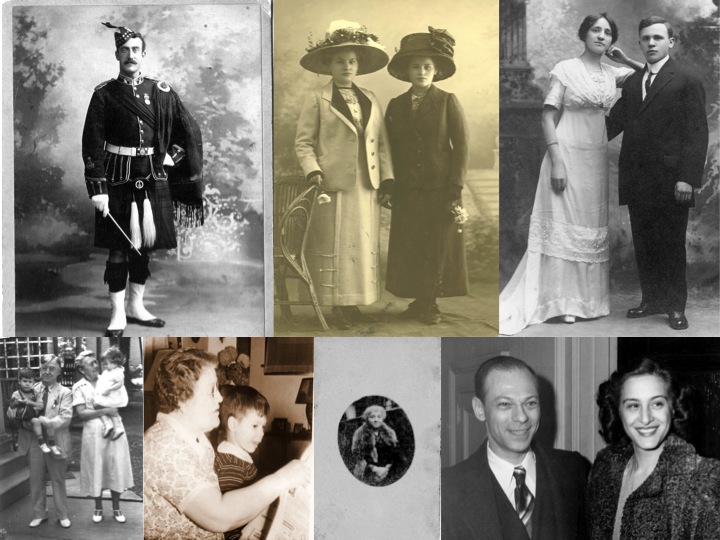

Case in point: In researching James, a New York-born man on my husband's side of the tree, I discovered that he volunteered for the Canadian Overseas Expeditionary Force in October, 1915, for World War I service.
At the time, James was a clerk living in Saskatoon, married with four children. The youngest child was just 2 years old!
Still, he volunteered, signed his attestation paper, and was pronounced physically fit by the physician who examined him.
Yet the handwritten note says he was "discharged Nov 1915, unlikely to become an efficient soldier."
Why? Because, depending on which birth year I believe, James was either 43 or 44 years old.
I'm not revealing his full name, but I am wondering what his wife thought about the idea of her husband, approaching middle age and with a growing family to support, volunteering for the military to get sent overseas.
Was this unexpected and unwelcome news?! I've never seen a notation like this--quite unexpected.
"Unexpected" is this week's genealogy prompt for Amy Johnson Crow's 52 Ancestors in 52 Weeks series.

That would be a surprise and I think you are right about his age being a factor. If he had 4 young kids, he might have seen military service as a way to get away from the chaos of little ones. I doubt that his wife would have been very pleased about his signing up!
ReplyDeleteI don't even know whether James told her he had applied!
DeleteI have seen this note before, but because of behavioural issues rather than age.
ReplyDeleteDifficult to know if his wife was relieved or not when he was rejected. Hope for her sake it was the former.
Wow. Could be behavioral here as well, I have no way to know. Likely age was a major factor since this was early in the war.
DeleteOne would have to wonder what he was running away from at home.
ReplyDeleteI asked Google AI to comment, here is response.
ReplyDelete“That specific phrase was a standard administrative "catch-all" used by the military during World War I, but in this man's context, several factors likely triggered it:
Age and Physicality: At 44, he was at the very upper limit for enlistment. By November 1915, the Canadian Expeditionary Force was realizing that older recruits often lacked the stamina for the physical rigours of trench warfare and were prone to chronic ailments (like rheumatism or heart issues) that didn't show up in the initial five-minute medical exam.
The "Breadwinner" Factor: With four young children (including a toddler), he might have been struggling with "domestic distress." If his wife or family wrote to his commanding officer pleading for his return due to financial hardship or lack of support at home, the military often used "unlikely to become efficient" as a polite way to discharge him without labeling him a deserter or a coward.
Training Performance: It may simply mean he couldn't keep up with the drills. If he was slow to learn modern tactics or struggled with the heavy marching, the army preferred to cut their losses early rather than ship a "liability" overseas.
Essentially, it wasn't necessarily a slur on his character; it was the military's way of saying he was more of a burden than an asset to a combat unit, likely due to a mix of his age and his heavy family responsibilities”
I agree that this wasn't a slur on his character, it was recognition that he was at the older end of the eligibility range and also that his family situation could interfere with his ability to be an efficient soldier. TY for your comment!
DeleteHave you looked at the corresponding personnel file (if there was one)? They are on Ancestry as well as at the Library and Archives Canada.
ReplyDeleteOnly his attestation papers are available, showing discharge notation. No personnel file found :(
Delete